Nigel Farage’s Aide Lost $715K on Polymarket Betting Against US Iran Strikes. Here’s Every Trade.
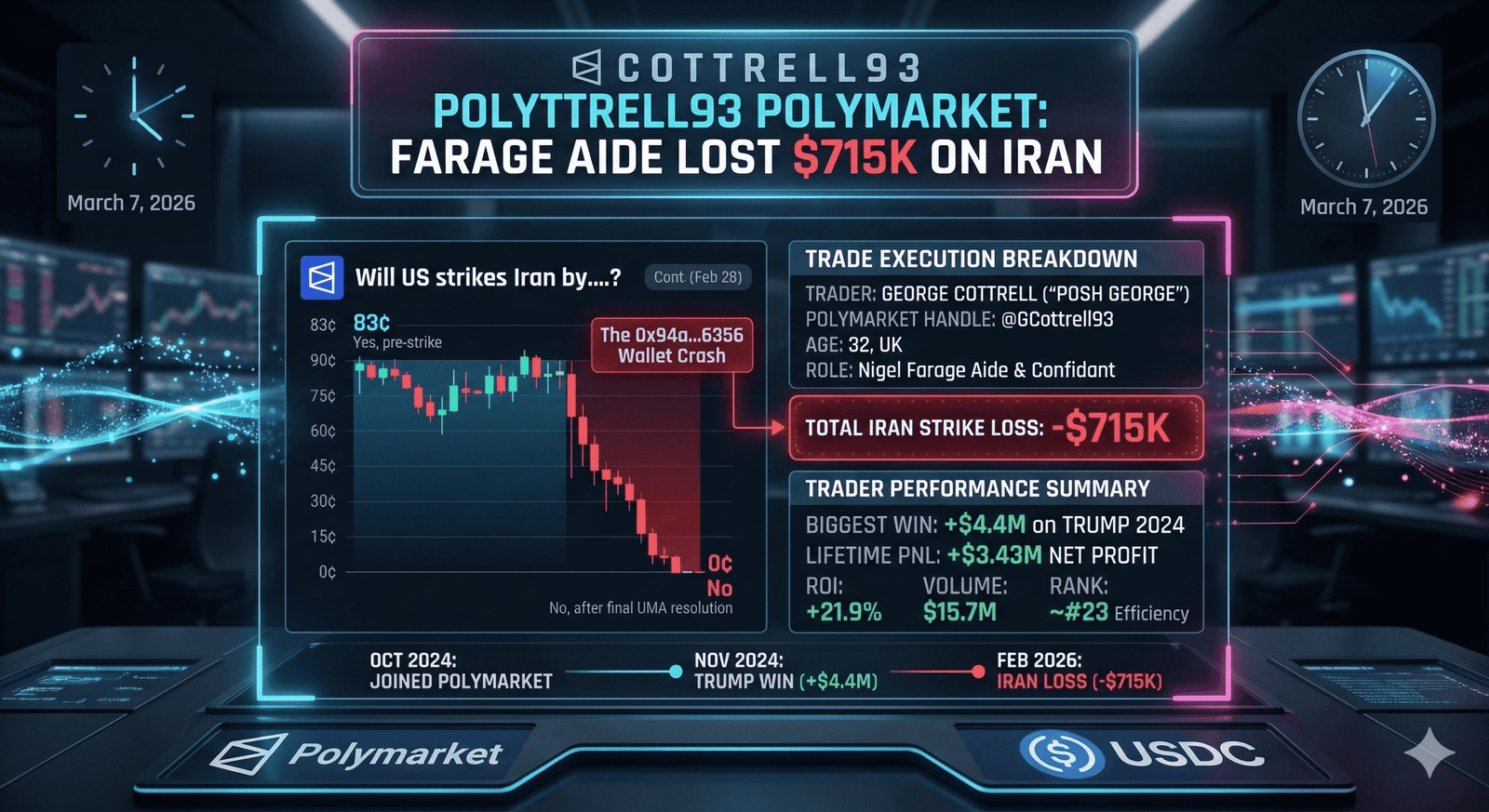
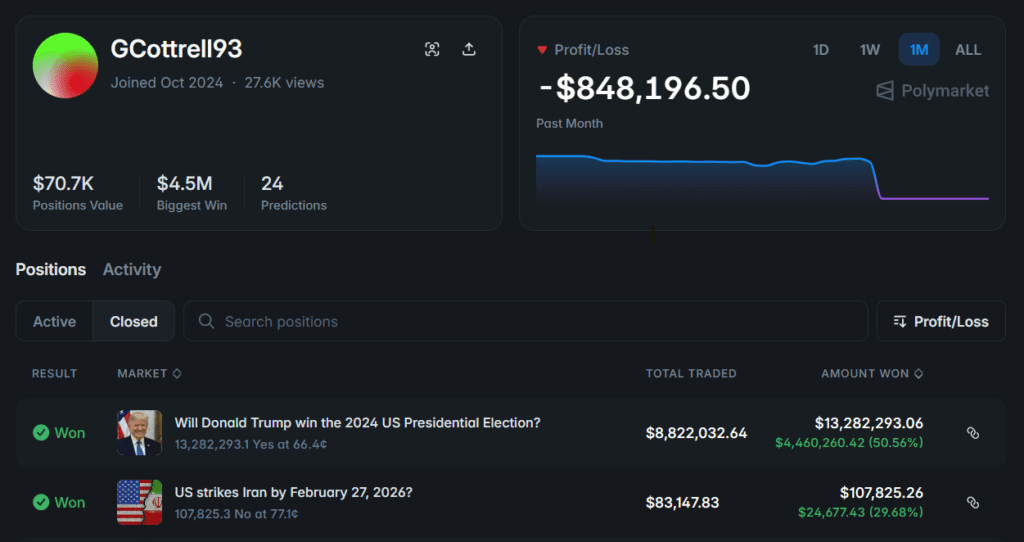
TL;DR: GCottrell93 Polymarket trader George Cottrell, 32, political aide to Nigel Farage and author of How to Launder Money, lost $715K in a single weekend betting the US would not strike Iran. He had farmed the same thesis for weeks collecting consistent profits. Then February 28 happened. Here is every position, every number, and what he is doing now.
Source: Polymarket.com
The Trade at a Glance
| Data Point | Detail |
|---|---|
| Trader | George Cottrell (“Posh George”) |
| Polymarket Handle | @GCottrell93 |
| Wallet Address | 0x94a428cfa4f84b264e01f70d93d02bc96cb36356 |
| Age | 32, UK |
| Role | Political aide and confidant to Nigel Farage |
| Joined Polymarket | October 2024 |
| Biggest Ever Win | +$4.4M on Trump 2024 presidential victory |
| Lifetime PnL | +$3.43M net profit on $15.7M volume (ROI +21.9%) |
| Leaderboard Rank | ~#23 efficiency (Polycopy) |
| Total Iran Strike Loss | ~$715K |
| Largest Single Loss | $551,009 (Feb 28 contract) |
| Current Positions Value | $70.3K (scaled way down) |
Who Is GCottrell93?
George Cottrell is not an anonymous wallet. Unlike most Polymarket whales, he has a real name, a real face, and a real-world reason to understand geopolitical risk better than almost anyone on the platform.
At 32, Cottrell serves as a political aide and close confidant to Nigel Farage, leader of the UK Reform Party. He has an aristocratic background that earned him the nickname “Posh George.” He also authored a book titled How to Launder Money, which tells you something about his relationship with financial edge cases. His profile got even more unusual after crypto investigator ZachXBT previously linked him publicly, adding yet another layer to an already rare public identity for a prediction market whale.
His biggest Polymarket trade to date was a +$4.4M win on Trump’s 2024 presidential victory. That single trade cemented his reputation as a high-conviction political bettor with real geopolitical access and genuine analytical edge. Overall, his lifetime PnL of +$3.43M on $15.7M volume reflects a 21.9% ROI that places him around #23 on efficiency leaderboards.
However, February 28, 2026 cut deeply into all of that.
The Losing Trades: Every Position Broken Down
The Main Hit: “US Strikes Iran by February 28?”
This was the trade that went viral and the one DL News, The Telegraph, and Yahoo Finance all covered when the story broke on March 6.
| Detail | Data |
|---|---|
| Market | Will the US strike Iran by February 28, 2026? |
| Position | No |
| Shares | 692,259.9 |
| Average Entry Price | 79.6¢ |
| Resolution | Yes (actual strikes confirmed Feb 28) |
| Settlement Price | 0¢ |
| Realized Loss | $551,009 |
At 79.6¢ average entry, Cottrell was paying close to the implied 80% probability that no strike would happen before February 28. In fact, that was a reasonable read for weeks. Diplomatic back-channels were active, Oman mediation was ongoing, and Trump’s posturing had not yet hardened into action. The No thesis had already produced profits on earlier deadlines.
Then, without warning, the strikes happened on the exact deadline date.
As a result, binary settlement meant no gradual exit. The 692,259 No shares went from 79.6¢ to 0¢ in one block. Half a million dollars, gone in a single resolution.
The Additional Positions That Extended the Damage
The $551K loss was not the full picture. Cottrell had layered further Iran timing exposure across later dates:
| Market | Position | Entry | Loss |
|---|---|---|---|
| US strikes Iran by March 15? | No | 55¢ | $110,000 |
| US strikes Iran by March 31? | No | 42¢ | $41,999 |
| No strike by Feb 28 (flip) | No | various | $12,115 |
| Total Iran wipeout | ~$715K |
Moreover, the March 15 and March 31 positions are particularly instructive. After the February 28 strikes confirmed, those contracts should have been obvious exits. Whether Cottrell held them as a fade on further escalation or simply did not act fast enough is unclear. Either way, they added another $152K to an already painful weekend.
The One That Worked the Day Before
For full context: on February 27, Cottrell correctly bet that no strike would happen by that specific date and pocketed +$107K. One day earlier and the same thesis was right. One day later and it cost him $551K.
This is the sharpest illustration of binary timing risk in recent Polymarket history. The thesis did not change. The calendar did.
Why This Went Viral Beyond Crypto Twitter
Typically, most large Polymarket losses stay inside the prediction market community. The GCottrell93 story jumped to mainstream media for one specific reason: the Farage connection.
Specifically, DL News broke the story on March 6. Subsequently, The Telegraph and Yahoo Finance picked it up within hours. The framing was consistent across all three: a political insider close to one of Britain’s most prominent populist politicians lost $715K betting against a US military strike on Iran.
The implicit question in every headline was the same: did his political access inform the trade? If Farage’s inner circle was betting heavily that the US would not strike Iran, what does that tell you about what they believed was happening diplomatically?
So far, Cottrell has not commented publicly. His current position sizing suggests he is not eager to draw further attention. But the story is now indexed across major financial media and will follow the GCottrell93 wallet for every future trade.
The Keir Starmer Loss Nobody Talked About
Additionally, buried underneath the Iran coverage, Cottrell also lost approximately $125K betting that Keir Starmer would be out of power by February 28.
Unsurprisingly, that contract resolved No. Starmer is still in office. The loss is relatively minor compared to the Iran total but adds context to the February 28 date specifically. Cottrell had multiple large positions all expiring on the same date, all going against him simultaneously.
In total, one bad date cost him roughly $840K across Iran and UK politics combined.
What He Is Doing Now
As of March 7, GCottrell93 has scaled significantly down from his prior sizing. Current open positions total $70.3K, a fraction of his prior sizing. The active bets are small and diversified:
J.D. Vance 2028 GOP nomination (Yes, unrealized -$10.5K), still playing US political markets but at a fraction of his previous size.
US x Iran ceasefire by June 30 (No, small position), notably, he is still in the Iran space, this time fading a quick ceasefire rather than fading a strike.
Minor European politics bets across Germany CDU, Hungary Fidesz, and France Bardella, consistent with his political background and analytical edge on European elections.
Overall, the pattern is a trader who took a significant hit, recognized the tail risk of concentrated binary exposure, and is rebuilding carefully in his area of genuine expertise: political markets where his access and background provide a real edge.
Why the Strategy Was Sound Until It Wasn’t
Interestingly, the same structural problem that hit anoin123 hit Cottrell, just with a real name attached.
First, the logic was defensible. No-strike contracts at 79.6¢ reflected legitimate probability. Oman was mediating. Geneva talks had produced “progress.” Trump had not yet hardened his position publicly. Multiple earlier deadlines had passed without incident. In fact, every prior win reinforced the thesis.
However, the fatal flaw was date concentration. Holding a massive position on the specific February 28 deadline while also holding March 15 and March 31 positions meant that the same event, a confirmed strike, resolved all positions simultaneously against him. There was no diversification benefit and no partial hedge.
Furthermore, binary markets punish this structure perfectly. There is no stop loss on a binary contract. When the February 28 No shares resolved at 0¢, that was it. The full $551K gone in one settlement block.
The +$107K win on February 27 is the cruelest detail. He was right up until the moment it mattered.
Key Takeaways for CoinTrenches Readers
- Real-world access does not prevent binary blowups. Cottrell has political connections that most Polymarket traders can only imagine. It did not protect him from a $715K loss when the binary resolved against his position.
- Date concentration is the hidden risk. Having large No positions on Feb 28, March 15, and March 31 looks like diversification. In practice, it is three positions all exposed to the same single event: a confirmed strike. When it happened, all three moved against him.
- The Feb 27 win makes the Feb 28 loss worse, not better. Being right the day before does not reduce the damage of being wrong on the actual deadline. Binary timing bets require getting the exact date right, not the general thesis.
- Scaling down after a blowup is the correct move. Cottrell went from hundreds of thousands per position to $70K total exposure. That is not giving up. That is sensible bankroll management after a tail-risk event.
- When a doxxed whale loses, it stays public forever. Anonymous wallets absorb losses quietly. GCottrell93 is now indexed across DL News, The Telegraph, and Yahoo Finance. Every future trade will be scrutinized through that lens.
Keep Reading on CoinTrenches
- 🔴 anoin123 Polymarket: $6.5M Lost on Iran No War Bet, the largest Iran No blowup, same thesis, even bigger scale
- 💥 How the US Strike Iran Market Paid Out, $500M Volume and the Winners, the contract that wiped both Cottrell and anoin123
- 🐋 This Whale Stands to Make Millions If the Iranian Regime Falls by March 31, who is on the winning side of Iran markets right now
- 🔍 ZachXBT Axiom Investigation: Whale Wallets Net $1.5M in Prediction Markets, Cottrell has prior ZachXBT links; this is the investigation context
- 👑 Polymarket Khamenei Out 2026: $57M in Payouts and the Wallets to Watch, the follow-on Iran market Cottrell is now lightly positioned in
This article is for informational purposes only and does not constitute financial advice. Polymarket odds change rapidly, always do your own research. Full disclaimer