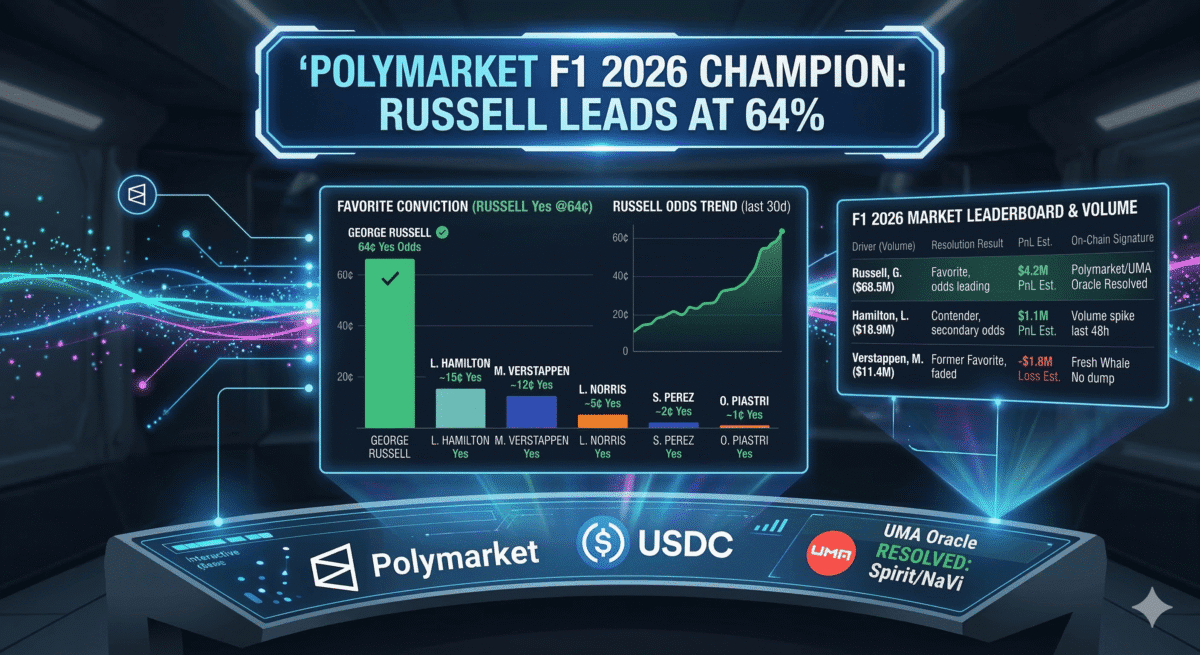
Mercedes Dominated Two Races. George Russell Is Now 64% to Win the 2026 F1 Title on Polymarket.
TL;DR: The Polymarket F1 2026 Drivers Champion market has shifted dramatically since preseason. George Russell sits at after back-to-back Mercedes dominance in Australia and China. Max Verstappen, who was considered the likely multi-year champion heading into the season, now sits at just alongside rookie Kimi Antonelli at . With $203.1M in total volume, 22 outcomes, and a December 6 resolution, this is one of the deepest long-horizon sports futures on the platform. Here is every live odds level, every driver context, and what the 2026 regulation reset actually means for who wins this title.

Polymarket F1 2026 Drivers Champion: Market at a Glance
| Data Point | Detail |
|---|---|
| Market | 2026 F1 Drivers Champion |
| Resolution Date | December 6, 2026 (after Abu Dhabi finale) |
| Resolution Source | Official FIA 2026 Drivers Championship standings |
| Total Volume | $203.1M |
| 24hr Volume | $20.2K |
| 1-Week Volume | $402.4K |
| Total Outcomes | 22 drivers |
| Current Leader (Market) | George Russell |
| Current Leader (Standings) | George Russell — 33 pts |
| Biggest Surprise | Max Verstappen after 2 races |
| Volume Leader | Lewis Hamilton — $5.5M despite odds |
Live 2026 F1 Championship Standings
The table below updates automatically via server-side API fetch after each race weekend.
| # | Driver | Team | PTS | W |
|---|---|---|---|---|
| emoji_events | George Russell | Mercedes | 33 | 1 |
| 2 | Kimi Antonelli | Mercedes | 22 | 0 |
| 3 | Charles Leclerc | Ferrari | 22 | 0 |
| 4 | Lewis Hamilton | Ferrari | 18 | 0 |
| 5 | Lando Norris | McLaren | 15 | 0 |
| 6 | Max Verstappen | Red Bull | 8 | 0 |
| 7 | Oliver Bearman | Haas | 7 | 0 |
| 8 | Arvid Lindblad | Racing Bulls | 4 | 0 |
| 9 | Oscar Piastri | McLaren | 3 | 0 |
| 10 | Gabriel Bortoleto | Audi | 2 | 0 |
📋 Standings after Round 2 — China GP · Updated manually after each race
Why the 2026 Regulation Reset Changed Everything
The 2026 season carries the biggest regulatory overhaul in Formula 1 in decades. Understanding these changes is essential for reading the Polymarket F1 2026 Drivers Champion odds correctly — because the shifts in competitive order are structural, not a temporary form wobble.
Active Aero Replaces DRS
Traditional DRS — the drag reduction system that opened rear wing flaps on straights — no longer exists in 2026. Instead, both front and rear wings use active aerodynamic systems that automatically adjust throughout the lap. This change fundamentally alters car development priorities and removes a key passing mechanism that had defined F1 racing since 2011. Teams that understood the active aero philosophy in testing built cars with completely different handling characteristics, and Mercedes and Ferrari clearly led that understanding from round one.
Power Units Now Split 50/50 Electric
The new 2026 power unit regulations require approximately equal power contribution from the internal combustion engine and the electrical system. As a result, battery management, energy recovery, and deployment strategy now carry as much importance as raw engine performance. Mercedes — with its long-standing hybrid expertise — entered the season as the team most likely to maximise this balance. Two races in, the results confirm that advantage entirely.
Smaller, Lighter Cars with Less Downforce
The 2026 cars are smaller and lighter than their predecessors, with reduced aerodynamic downforce generated by the floor. This change specifically removes the ground-effect advantage that Red Bull and McLaren developed into dominant tools under the 2022–2025 regulations. Both teams built their recent championships around ground-effect expertise — and both teams now find themselves off the pace as that expertise becomes less relevant. The combined effect of these three regulatory changes explains why the Polymarket F1 2026 Drivers Champion odds show Russell at rather than Verstappen.
Polymarket F1 2026 Drivers Champion: Full Odds Breakdown

George Russell — — Vol: $2.8M
Russell leads the Polymarket F1 2026 Drivers Champion market at for concrete reasons. He currently tops the real championship standings with 33 points, his team built the best car under the 2026 regulations, and his driving style — characterised by smooth mechanical grip and precise tyre management — suits the new active aero philosophy better than most. The key question at is whether this early dominance reflects a lasting structural advantage or a head start that rivals will close. Historically, the 2026 changes are more fundamental than the 2022 reset, and Mercedes’ advantage appears structural rather than merely developmental. At current odds, Russell offers 36¢ of profit per share — a 56% return on a driver leading both the standings and the market after two rounds.
Kimi Antonelli — — Vol: $4.4M
Antonelli is the most interesting long-shot narrative in this market. At 18 years old, he already sits second in the real championship with 22 points, and his $4.4M in trading volume — highest among all non-Russell drivers — reflects the scale of trader interest in the “next generational talent” story. The bull case at is straightforward: Antonelli drives the same car as Russell, so the question becomes whether Russell’s experience advantage is large enough to consistently outscore an 18-year-old rookie across 24 races. The bear case is equally clear — rookie errors under pressure in a championship fight can be decisive, and Mercedes will likely use team orders to prioritise Russell at critical strategic moments.
Max Verstappen — — Vol: $6.2M
Verstappen at is the most debated number in the entire market. At 9% implied probability, the market prices roughly a 1-in-11 chance the four-time champion wins the 2026 title. His qualifying disaster and recovery from P20 to P6 in Australia shows both the scale of Red Bull’s current problem and the scale of his individual talent. Historically, Red Bull has made dramatic mid-season development jumps — most notably in 2022, when they absorbed ground-effect rules faster than Mercedes expected. Furthermore, Verstappen’s recent contract extension signals he has no intention of moving. Watch Red Bull’s development updates at each round as the key signal for whether becomes a buying opportunity.
Charles Leclerc — — Vol: $5.4M
Leclerc at reflects Ferrari’s current second-place position in the Constructors standings and their consistent podium pace. The case for Leclerc centres on Ferrari being a genuine challenger if their development rate continues and if Mercedes hits reliability problems in a complex new power unit cycle. However, the case against him rests on Ferrari’s well-documented pattern of strategic errors and mid-season development stagnation — and having Lewis Hamilton as a teammate adds an internal competitive threat that historically consumes Ferrari’s strategic focus at critical moments.
Lewis Hamilton — — Vol: $5.5M
Hamilton’s $5.5M in trading volume is the clearest example of name-recognition trading distorting market prices in the Polymarket F1 2026 Drivers Champion market. At 41 years old and in his first season with Ferrari after over a decade at Mercedes, Hamilton carries both the largest volume and one of the worst odds-to-volume ratios in the market. The bull case requires Ferrari to develop faster than Mercedes across 22 remaining races while Hamilton simultaneously adapts to a new car, new team culture, and new power unit in the most regulatory-disrupted season in a generation. At , he represents either extraordinary value for those who believe in his adaptability — or a name-recognition trap for traders who buy the seven-time champion narrative without pricing the structural obstacles.
Lando Norris — — Vol: $6.8M
Oscar Piastri — — Vol: $6.5M
McLaren’s collapse from preseason favourites to mid-pack competitors represents the sharpest odds correction in this market. Both Norris and Piastri sit below 3.5¢ after McLaren’s active aero adaptation problems and race incidents in the opening two rounds. McLaren won the 2025 Constructors Championship by mastering ground-effect aerodynamics — and the 2026 rules specifically removed that advantage. At and respectively, those prices only make sense as buys if you believe McLaren can close a multi-second deficit to Mercedes before summer.
Three Scenarios That Could Still Flip the Polymarket F1 2026 Drivers Champion Odds
With 22 races remaining on the 2026 F1 calendar, three specific scenarios could materially shift the Polymarket F1 2026 Drivers Champion market before the Abu Dhabi finale.
A Mercedes reliability crisis. The 2026 power units are the most complex in F1 history — more electrical integration means more failure modes. If Mercedes suffers repeated mechanical DNFs, Russell’s championship lead evaporates quickly and the market simultaneously reprices toward Leclerc and Verstappen. Consequently, No on Russell and Yes on Leclerc is the most natural hedging pair in this market.
Red Bull’s development cycle activates. Red Bull recovered from regulation resets before, most notably in 2022 when they absorbed the ground-effect rules faster than Mercedes expected. If their development rate in the first flyaway races shows meaningful competitive improvement, Verstappen’s becomes significantly underpriced — and the market will move before any public confirmation of the gap closing.
An Antonelli-Russell intra-team battle. If Antonelli closes the points gap to Russell through the European summer races, Mercedes faces a difficult strategic choice. A team order dispute in a closely contested intra-team fight could destabilise both drivers’ campaigns and hand Leclerc or Verstappen unexpected title opportunities. For context on how quickly long-horizon Polymarket futures reprice when early leaders face setbacks, the Polymarket UCL 2026 market shows Arsenal at carrying a similar early-leader dynamic.
Key Takeaways for CoinTrenches Readers
Russell at reflects a structural advantage, not just form. The 2026 regulation reset specifically benefits Mercedes’ engineering philosophy. Two races of evidence support the market pricing. Nevertheless, 22 races remain and reliability risk in a novel power unit design is real — that uncertainty is what keeps the odds from 80¢+.
Antonelli’s $4.4M volume reflects genuine uncertainty about whether Russell’s teammate beats him. At , a title-winning Antonelli performance would generate significant returns. The risk is that team orders and rookie pressure combine to suppress his championship potential at critical moments.
Verstappen at is the most debated position in the market. Four-time champions do not stay at 8 points after round two without attracting strong recovery believers. Consequently, watch Red Bull’s development updates at each round as the primary signal for whether was a buying opportunity all along.
Hamilton’s $5.5M volume at is a name-recognition premium. The odds accurately reflect his structural disadvantage. The volume, however, reflects his global fanbase trading on narrative rather than probability.
McLaren’s collapse is the biggest story nobody is talking about. Defending champions Norris and Piastri sitting at and shows how completely the 2026 rules reset the competitive order. Their recovery timeline is the most important variable for the mid-season Polymarket F1 2026 Drivers Champion odds.
Keep Reading on CoinTrenches
- ⚽ Polymarket UEFA Champions League 2026: Arsenal at 29% with $271M Volume — another long-horizon sports futures market with similar early-leader dynamics
- 🏀 Polymarket 2026 NBA Champion: Thunder at 36% and Smart Money Piling In — how the NBA title market compares structurally to F1 futures
- 🏠 HorizonSplendidView: $2.37M on Man City Loss — how single sports events create whale-scale opportunities within long-season markets
- 🐋 Polymarket Sports Bot Whale: $615K in One Day, No Name, No Profile — the high-frequency approach to sports markets vs long-horizon futures positioning
- 🔍 ZachXBT Axiom Investigation: Whale Wallets Net $1.5M — how coordinated wallet clusters approach long-duration futures across all categories
This article is for informational purposes only and does not constitute financial advice. Polymarket odds change rapidly — always do your own research. Full disclaimer →