The US and Israel Already Struck Iran. Now Polymarket Is Pricing Whether 13 Other Countries Join.
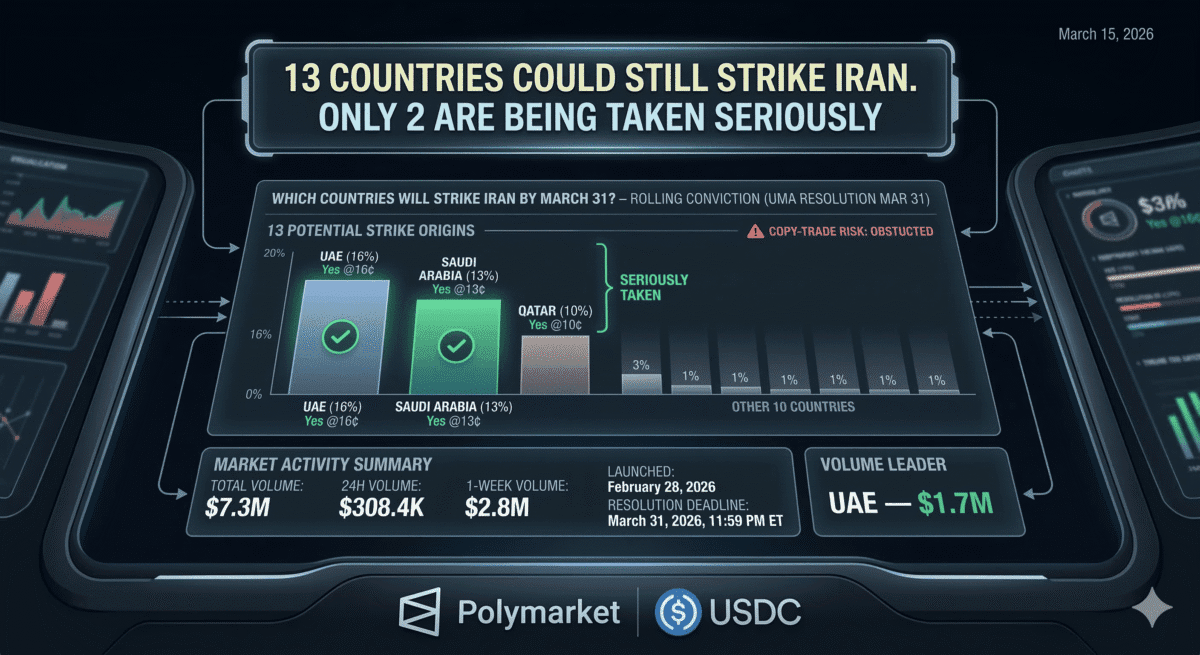
TL;DR: The Polymarket which countries will strike Iran market runs 13 independent Yes/No outcomes — one for each country or group that could join the escalation before March 31. UAE leads at . Saudi Arabia sits at . Qatar holds at . Every other outcome falls below 8¢. US and Israel are excluded because their strikes already happened. With $11.4M in total volume and just 16 days left on the clock, here is every live odds level, every resolution rule, and what actually moves these markets before the deadline.
Polymarket Which Countries Will Strike Iran: Market at a Glance
| Data Point | Detail |
|---|---|
| Market | Which countries will strike Iran by March 31? |
| Resolution Deadline | March 31, 2026, 11:59 PM ET |
| Total Volume | $11.4M |
| 24hr Volume | – |
| 1-Week Volume | – |
| Launched | February 28, 2026 |
| Total Outcomes | 13 independent country/group binaries |
| Top Outcome (odds) | UAE |
| Top Outcome (volume) | UAE — $2.9M |
| Second (odds) | Saudi Arabia |
| Third (odds) | Qatar |
Resolution Rules: What Counts as a Strike
Each outcome in the Polymarket which countries will strike Iran market resolves Yes only if that specific country initiates a drone, missile, or air strike on Iranian soil or any official Iranian embassy or consulate by March 31.
Crucially, the exclusion list is long and precise. Cyber attacks do not count. Economic sanctions do not count. Proxy actions through militias do not count. Naval operations and blockades do not count. Threats and political statements do not count. The strike must be a direct kinetic action that a named country launched against Iranian territory or diplomatic facilities.
US and Israel are both excluded from this market entirely because their strikes already happened — the February 28 strikes and the March 13–14 Kharg Island operation. Consequently, this market specifically asks whether the conflict pulls in any of the regional or Western powers that have not yet acted. Resolution uses credible open-source reporting from Reuters, AP, and official government statements, with Polymarket’s UMA oracle handling any disputes.
Polymarket Which Countries Will Strike Iran: Full Odds Breakdown
UAE — — Vol: $2.9M
UAE leads the Polymarket which countries will strike Iran market at — the highest probability of any outcome, with $2.9M in single-outcome volume to match. The logic centres on the Strait of Hormuz: UAE ships roughly 30% of its non-oil trade through the strait, so a confirmed Iranian closure hits UAE’s economy immediately and directly. Trump’s explicit threat to respond if Iran keeps blocking Hormuz creates a scenario where UAE faces a choice between joining a US-led coalition strike or watching its trade routes stay shut. Notably, UAE’s odds moved approximately 2–3¢ higher following the March 13–14 Kharg Island strikes — suggesting the market believes US military action increases rather than decreases the probability of Gulf state participation.
Saudi Arabia — — Vol: $2.3M
Saudi Arabia sits just below UAE at with $2.3M in volume. The Saudi case mirrors UAE’s structural logic — Hormuz closure directly threatens Saudi Arabia’s oil export revenue, which underpins the entire state budget. However, the Saudi position is more diplomatically complicated: Saudi Arabia has been cautiously managing its relationship with Iran through back-channel talks even as US-Iran tensions escalated. A direct Saudi strike would therefore represent a complete reversal of that diplomatic positioning, and the market prices as the probability that Hormuz disruption or US pressure forces that reversal within 16 days.
Qatar — — Vol: $1.0M
Qatar at presents an unusual dynamic — the country hosts the largest US military base in the region (Al Udeid Air Base) while simultaneously maintaining its own diplomatic relationship with Iran to co-manage the shared South Pars/North Dome gas field. A direct Qatari strike on Iran would jeopardise that gas field relationship. Consequently, traders price as the scenario where US base pressure overrides Qatar’s gas field diplomacy entirely.
Any EU Country — — Vol: –
The EU outcome at covers any strike from any European Union member state against Iran. At 7%, the market reflects the near-complete absence of political will among European governments to conduct offensive military operations without explicit NATO consensus and UN Security Council authorisation — neither of which exists. Germany, France, and Italy have all publicly opposed military escalation, and any EU strike would require a political transformation that 16 days simply cannot accommodate.
Bahrain — — Vol: $434.2K
Bahrain hosts the US Navy’s Fifth Fleet and sits geographically between the contested Hormuz region and the Saudi mainland. At , the market prices a scenario where Bahrain’s hosting relationship and physical proximity draws it into a direct strike role alongside US forces.
UK — — Vol: $976.6K
UK sits at despite its historically closer alignment with US military operations than most European nations. The UK government has publicly condemned Iranian actions but shown no indication of independent offensive military planning. The only credible UK scenario involves a joint US-UK operation approved under parliamentary emergency session — a speed of political decision-making that UK institutions rarely achieve in 16 days.
Turkey — — Vol: $505.7K
Turkey at reflects Erdogan’s consistent pattern of escalatory rhetoric combined with reluctance to commit military assets to US-led operations outside NATO’s formal structure. Turkey’s complex relationship with both Iran and the US — plus its domestic political calculations — makes a direct Turkish strike among the least likely outcomes in the Gulf cluster despite Turkey’s significant military capability.
The Remaining Six: All Below 4¢
Kuwait (), France (), Jordan (), Oman (), Germany (), and Canada () all sit below 4¢ for structural reasons that 16 days cannot change. Kuwait faces a direct Iranian threat against the Mina Al-Ahmadi refinery — making its position uniquely defensive rather than offensive. France and Germany reflect the European diplomatic consensus against unilateral military action. Jordan and Oman have both pursued active mediation roles in the Iran crisis, making a strike decision politically self-contradictory. Canada is effectively a residual market with almost no realistic resolution path.
Three Events That Could Move the Polymarket Which Countries Will Strike Iran Odds Before March 31
With just 16 days remaining, three specific events could shift the Polymarket which countries will strike Iran odds materially before the deadline.
A confirmed Hormuz closure. If Iran mines or physically closes the Strait of Hormuz, UAE and Saudi Arabia face immediate economic pressure that pushes their strike probabilities significantly higher. A confirmed closure would likely push UAE from toward 25–30¢ and Saudi Arabia from toward 20–25¢ within hours — making the Hormuz closure market the single most important leading indicator for this entire outcome cluster.
A US formal coalition announcement. If the Trump administration publicly invites Gulf state participation in a follow-on Iran operation, the market simultaneously reprices every Gulf outcome. UAE and Saudi Arabia would likely approach 30–40¢ on a formal coalition invitation, and Qatar, Bahrain, and Kuwait would move in parallel.
An Iranian retaliatory strike on Gulf infrastructure. Iran has explicitly threatened the Mina Al-Ahmadi refinery in Kuwait. A successful Iranian strike on any Gulf state infrastructure would immediately create domestic political pressure in that country to respond. For context on how rapidly Iran market prices move after a single escalation event, the anoin123 $6.5M Iran blowup happened in a single overnight session after the February 28 strikes — the same repricing speed applies here if Iran retaliates against Gulf targets.
How This Market Connects to the Broader Iran Cluster
The Polymarket which countries will strike Iran market sits within a broad cluster of inter-related Iran markets that all share the March 31 deadline. Understanding the cluster helps you price each outcome correctly.
The US forces enter Iran ground market prices terrestrial entry by March 31 at 27%. A confirmed ground operation creates the political conditions under which Gulf states face the strongest pressure to join formally — consequently, the two markets move together on that trigger. The Kharg Island control market sits at 88% No for an Iranian control change, but the related Kharg Island oil terminal hit market sits at 33% Yes — and a terminal strike would represent a direct escalation that transforms Gulf state risk calculations overnight. Finally, the broader “military action against Iran continues through March 31” market prices at 83% Yes, reflecting that the conflict extends regardless of whether third countries join. That 83% backdrop is the context in which every outcome in the Polymarket which countries will strike Iran market prices its specific probability.
Key Takeaways for CoinTrenches Readers
UAE and Saudi Arabia are the only outcomes worth analysing seriously. At and , both are genuinely contingent on Hormuz developments. Every other country in this market sits below 8¢ for structural reasons that 16 days cannot change.
Hormuz is the trigger mechanism for the Gulf state outcomes. Watch the Hormuz closure market as the leading indicator. Any confirmed closure immediately reprices UAE and Saudi — and the $2.9M in UAE volume alone tells you serious capital is already positioned for that scenario.
The kinetic strike requirement excludes most escalation scenarios. Sanctions, cyber attacks, naval operations, and proxy actions all fail the resolution standard. Only a direct drone, missile, or air strike resolves Yes for any of the 13 outcomes — that standard eliminates the majority of likely escalation paths in the next 16 days.
Iran retaliating against Gulf infrastructure changes everything. An Iranian strike on a Gulf state creates domestic political pressure to respond directly. That scenario is the most plausible path to Yes on UAE, Saudi, or Kuwait that does not require a formal US coalition invitation — and it can happen without warning, as the broader Iran cluster has demonstrated repeatedly.
This market already has $11.4M in volume since launching February 28. That pace reflects serious trader interest in third-country escalation as a genuine possibility. The volume itself is a signal that sophisticated capital believes these outcomes are not purely theoretical — even at as the market ceiling.
Keep Reading on CoinTrenches
- [Live] Polymarket US Forces Enter Iran: 57% by December, 27% by March — the ground entry market that drives Gulf state coalition probability
- Polymarket Kharg Island: US Bombed It. Iran Still Owns It. — the Kharg control market whose resolution connects directly to Gulf state escalation odds
- [Live] Polymarket Crude Oil $100: 89% Yes and 3 Weeks Left — the commodity market that spikes on any additional Gulf state strike
- anoin123 Polymarket: $6.5M Lost on Iran No War Bet — what overnight Iran escalation does to unprepared binary positions
- Polymarket Khamenei Out 2026: $57M in Payouts — the regime leadership market that feeds into coalition escalation probability
This article is for informational purposes only and does not constitute financial advice. Polymarket odds change rapidly — always do your own research. Full disclaimer →
![[Live] Polymarket US Forces Enter Iran: 57% by Dec](https://cointrenches.io/wp-content/uploads/2026/03/Live-Polymarket-US-Forces-Enter-Iran-57-by-Dec-768x419.png)