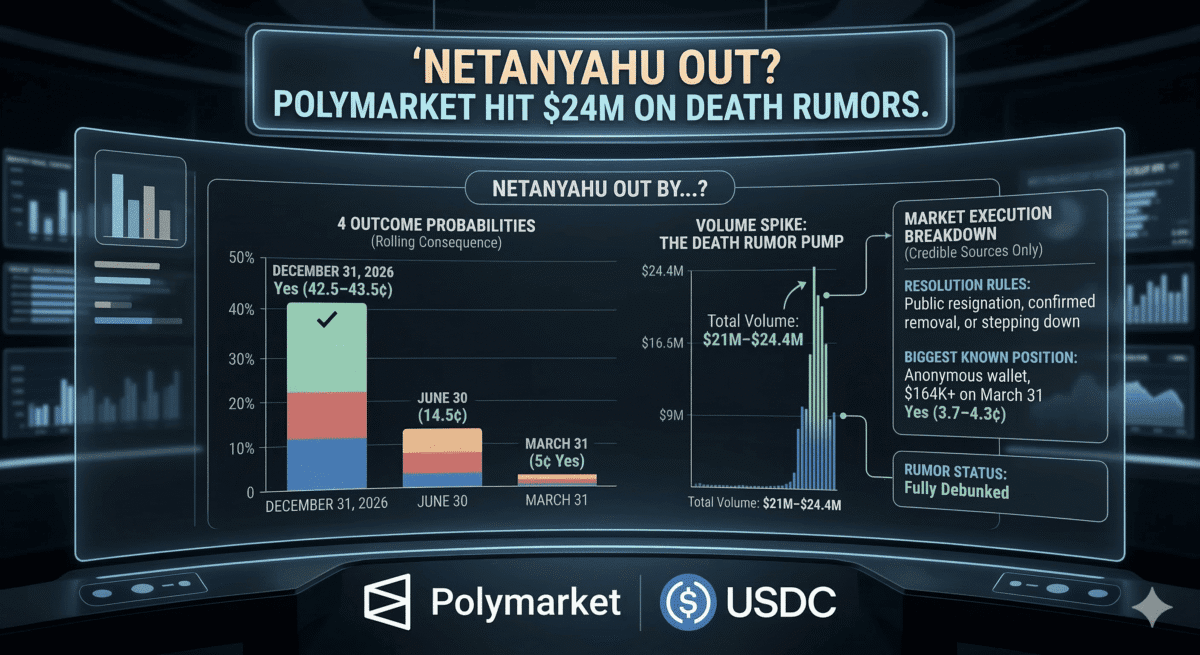
The Netanyahu Death Rumors Are Debunked. Someone Just Bet $164K on March 31 Yes at 4¢ Anyway.
TL;DR: TTL;DR: The Polymarket Netanyahu out market hit $124.4M in total volume after Iranian media and social media conspiracy theories sparked viral death and missing-person rumors on March 15–16. The rumors are debunked. Netanyahu appeared on video buying coffee, walking outdoors, and holding face-to-face military briefings. Despite the debunking, one wallet loaded $164K on March 31 Yes at 3.7–4.3¢. December 31 leads the market at . Here is every live odds level, every confirmed position, and why the rumor spike created both a lottery trade and a sharp contrarian opportunity simultaneously.
Polymarket Netanyahu Out: Market at a Glance
| Data Point | Detail |
|---|---|
| Market | Netanyahu out by…? |
| Resolution Rules | Public resignation, confirmed removal, or stepping down (credible sources only) |
| Total Volume | $124.4M |
| 24hr Volume | $13.2K |
| 1-Week Volume | $221.7K |
| 24h Volume Spike (March 15–16) | $9M–$11M |
| March 31 Yes | |
| June 30 Yes | |
| December 31 Yes (market leader) | |
| Biggest Known Position | Anonymous wallet, $164K+ on March 31 Yes at 3.7–4.3¢ |
| Rumor Status | Fully debunked by Israeli officials and multiple video appearances |
What Triggered the Explosion: The Rumor Chain
Understanding the Polymarket Netanyahu out volume spike requires tracing exactly how the rumor developed — because the speed and scale of the market reaction tells you something important about how prediction market odds respond to unverified information.
The Origin
The rumor chain started around March 13–15 in the aftermath of Iranian strikes that caused debris impacts in Israel, including damage to Tel Aviv apartments. Iranian state media and IRGC-linked accounts amplified claims that Netanyahu had been targeted and that Iran would “pursue and kill” him “if he’s still alive.” That framing — conditional and designed to generate uncertainty — launched the misinformation cycle that drove $124.4M in total market volume.
The Viral Fuel
Three separate claims then compounded the original rumor into a full viral event. First, a press conference video circulated on social media purporting to show Netanyahu with six fingers on his right hand, which conspiracy accounts used to argue the appearance was AI-generated. Second, his son’s social media silence combined with a low public profile during the escalation period generated “missing” claims that spread rapidly on X and Reddit. Third, false posts claiming Netanyahu’s family home had been struck and destroyed circulated widely — subsequently traced to unrelated US footage recirculated without context.
The Debunking
Israeli officials moved quickly. Netanyahu’s office issued a direct denial — and Netanyahu himself appeared publicly on multiple occasions. A video from a Jerusalem café showed him joking that he was “dead for coffee” while visibly showing his hands to counter the AI claim directly. A separate video confirmed an outdoor walk near Jerusalem with aides, IDF personnel, and civilians. Israeli officials also confirmed face-to-face military briefings were held. Reuters, Newsweek, the Jerusalem Post, and NDTV all dismissed the rumor as Iranian propaganda with no credible evidence.
Resolution Rules: What Actually Triggers a Yes
Before sizing any position in the Polymarket Netanyahu out market, the resolution standard is essential. This market resolves Yes only if Netanyahu publicly announces resignation, is confirmed removed from office, or formally steps down — all verified by credible sources like Reuters or AP or official Israeli government statements.
Crucially, temporary absences, acting prime minister designations, hospitalisation without formal removal, and any version of the current death rumors do not count. For December 31 Yes to resolve, a formal leadership transition must happen in Israeli politics before the end of 2026 — involving either a coalition collapse, a Knesset vote of no confidence, or Netanyahu choosing to step down. All are plausible scenarios in a long Israeli election cycle, but none are imminent as of today.
Polymarket Netanyahu Out: Live Odds Breakdown
March 31, 2026 — — Vol: $104.2M
March 31 sits at after briefly spiking higher during the peak rumor period before partially correcting on the debunking. At current prices, March 31 Yes represents a pure lottery structure — cheap entry with an enormous payout if Netanyahu formally exits in the next 15 days, but an almost certain zero given the debunking evidence and the absence of any confirmed political ouster mechanism operating on that timeline. The $659K–$1M+ volume on this outcome reflects rumor-driven buying rather than informed analytical positioning. Most of that volume entered at the peak of the cycle and now sits underwater as odds corrected downward.
June 30, 2026 — — Vol: $6.9M
June 30 at represents the medium-term political uncertainty thesis. Israeli coalition politics are genuinely unstable under wartime pressure — Arab parties and coalition factions have shown fractures amid the Iran escalation. An ouster or resignation by June is a real probability that the market prices honestly. Furthermore, at this price level, June 30 Yes offers a more considered speculative entry than March 31: the timeline is long enough for genuine political developments to unfold without requiring a specific near-term event.
December 31, 2026 — — Vol: $2.5M
December 31 is the market’s lead outcome at for a concrete reason. Israel’s next scheduled election falls around October 2026. Coalition dynamics under wartime conditions have historically produced leadership transitions on or near election cycles. The 43% implied probability reflects genuine analyst consensus that Netanyahu’s grip on the coalition becomes increasingly difficult to maintain through a full year of Iran escalation fallout, war fatigue, and domestic political pressure. Notably, the rumor spike did not fundamentally change this odds level — because the underlying political thesis does not depend on any specific short-term event.
The $164K Bet at 4¢: Who Is dududududu22?
The most discussed position in the current Polymarket Netanyahu out market is an anonymous wallet that loaded $164K+ on March 31 Yes at entry prices of 3.7–4.3¢.
Reports from on-chain alert feeds and X viral posts describe a cluster of up to seven new wallet accounts collectively positioning $104K–$150K+ on March 31 Yes at the bottom of the odds range. The pattern of fresh wallet creation combined with concentrated near-term Yes buying mirrors patterns seen in other Iran-related markets — most notably the fresh wallets that appeared before the February 28 strike resolution and collectively generated over $1.2M in profit.
That precedent is exactly why the trader comment section describes the bet as a potential “insider play.” The logic is straightforward: someone who bought US strike timing contracts at the bottom just before February 28 made a fortune. If a similar pattern applies here, the fresh wallet positioning on March 31 Yes before a rumored but unconfirmed Netanyahu health event could represent informed early positioning rather than rumor chasing.
The counterargument is equally clear, however. The debunking evidence is strong — multiple videos, official statements, and credible media consensus all point away from any genuine health crisis. At 4¢, the position is a lottery ticket that costs relatively little to hold. If the cost of being wrong is small and the potential upside is enormous, that entry structure can be rational even without insider information. Either way, anyone considering copying this trade should understand that March 31 Yes at resolves to zero unless Netanyahu formally exits within 15 days — an event with no current credible basis.
The Contrarian No Side: Quiet but Present
While the Yes side generated all the viral attention, scattered No accumulators on March 31 also appear in market comments — with reported chunks of $10K–$20K buying No at 94–96¢. These positions collect 4–6¢ per share on a near-certain outcome if the rumors remain debunked and no genuine political crisis materialises.
No large named wallet has publicly committed a mega-No position comparable to what appeared in other Iran binary markets. The asymmetry is familiar: winning the No side returns a small edge on a near-certain outcome, but losing the No side requires a historically unprecedented Israeli political collapse in 15 days. Most serious traders buying No do so quietly — not because the thesis is weak, but because the position is unsexy.
How This Market Connects to the Iran Cluster
The Polymarket Netanyahu out market does not move in isolation from the broader Iran escalation markets. Netanyahu’s political survival directly links to Israeli military posture, which connects to every active Iran market through the common escalation chain.
Specifically, a genuine Netanyahu resignation or removal would trigger an immediate Israeli leadership transition during active military operations against Iran. That transition creates uncertainty about Israeli military commitments, ceasefire negotiations, and Hormuz-related coalition positioning all at once — consequently, the Iran ceasefire market and the which countries strike Iran market would both reprice sharply on any confirmed Netanyahu exit. Conversely, Netanyahu remaining in power through March 31 — the near-certain outcome at current odds — keeps the current Israeli military posture intact and supports the existing pricing across the Iran cluster without additional volatility.
Key Takeaways for CoinTrenches Readers
The death rumors are debunked and multiple videos confirm it. Anyone buying March 31 Yes today does so knowing Netanyahu is confirmed alive, healthy, and operational. That is a pure lottery entry at 4–6¢ — not an informed reaction to credible intelligence. The $124.4M total market volume reflects rumor-driven FOMO, not analytical conviction.
The $164K fresh wallet bet is the one signal worth monitoring. Fresh wallet creation plus near-term Yes buying before a binary event has produced massive returns in Iran markets before. Watch whether this wallet adds to its position or exits before March 31 — that behaviour is the clearest indicator of whether this is insider positioning or rumor chasing.
December 31 at is the only analytically defensible entry. The political thesis for Netanyahu’s eventual exit — coalition fragility, wartime pressure, and an October 2026 election cycle — does not depend on any rumor. It prices a genuine structural reality in Israeli politics that existed before the viral cycle and will exist after it.
$9M+ in one day on a debunked rumor shows how fast prediction markets reprice on viral information. The speed of the $13.2K volume spike tells you that a genuine confirmed event — rather than a rumor — would move these odds even faster and further. Position sizing before confirmed news matters enormously.
No at 94–96¢ on March 31 is as close to free money as prediction markets offer. The position requires Netanyahu to remain in confirmed leadership for 15 more days. Every piece of available evidence supports that outcome. The 4–6¢ return is small — but the probability of collecting it is extremely high.
Keep Reading on CoinTrenches
- Polymarket Which Countries Strike Iran: UAE at 16% — the coalition escalation market linked to Israeli military posture
- Polymarket Kharg Island: US Bombed It. Iran Still Owns It. — the island control market that connects to Netanyahu’s survival timeline
- anoin123 Polymarket: $6.5M Lost on Iran No War Bet — what happens when a large Iran position meets a binary deadline
- GCottrell93 Polymarket: Nigel Farage’s Aide Lost $715K on Iran Bets — another case of correct analysis destroyed by a single resolution date
- Polymarket Khamenei Out 2026: $57M in Payouts — the parallel leadership market on the Iranian side of the same conflict
This article is for informational purposes only and does not constitute financial advice. Polymarket odds change rapidly — always do your own research. Full disclaimer →