Wall Street Says One Cut. Polymarket Says Maybe Zero. Here Is the Full $10.5M Fed Rate Market.
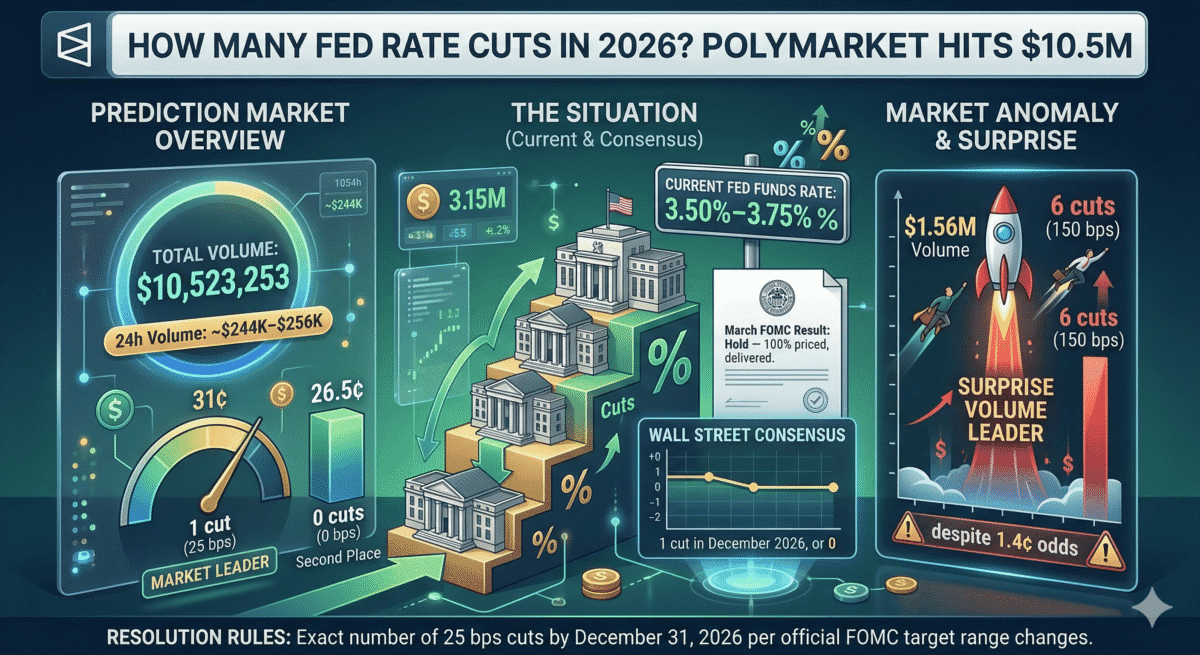
TL;DR: The Polymarket Fed rate cuts 2026 market has $53.1M in total volume across 13 independent outcomes, each representing a specific number of 25 basis point cuts. One cut leads at 31¢. Zero cuts sits right behind at 26.5¢. Two cuts holds at 22¢. Every outcome above three cuts collapses to single digits. Goldman Sachs, JPMorgan, and CME FedWatch all forecast one cut for 2026, likely in December. But the Iran conflict, oil shock risks, and sticky core inflation are keeping zero cuts as a genuine second-favourite. Here is every live outcome, the trader narratives driving the volume, and what actually moves this market before December.
Polymarket Fed Rate Cuts 2026: Market at a Glance
| Data Point | Detail |
|---|---|
| Market | How many Fed rate cuts in 2026? |
| Resolution Date | December 31, 2026 (after December FOMC meeting) |
| Resolution Source | Official FOMC target range changes only |
| Total Volume | $53.1M |
| 24hr Volume | $161.3K |
| 1-Week Volume | $1.4M |
| Market Leader | 31¢ — 1 cut (25 bps) |
| Second Place | 26.5¢ — 0 cuts (0 bps) |
| Current Fed Funds Rate | 3.50%–3.75% |
| Today’s FOMC Decision | 100% hold — no change |
| Surprise Volume Leader | 6 cuts at $1.56M despite 1.4¢ odds |
Why the Polymarket Fed Rate Cuts 2026 Market Looks the Way It Does
The Polymarket Fed rate cuts 2026 odds reflect a specific macroeconomic environment that has shifted significantly since the start of the year. At the beginning of 2026, consensus forecasts pointed toward two to three cuts as the Fed managed a soft landing scenario. Core PCE inflation was trending toward target and the labor market was cooling in a controlled way — traders priced that scenario into the higher cut outcomes, which explains why buckets like three and four cuts still carry meaningful volume despite their current low odds.
Then three things changed the picture. First, core PCE inflation remained sticky at approximately 2.7%, above the Fed’s 2% target by a margin that makes near-term cuts technically difficult to justify. Second, the Iran conflict and subsequent oil shock created new upside inflation risk that the Fed could not ignore even if labor market data alone would have justified a cut. Third, Trump’s public pressure on the Fed for rate reductions created the opposite institutional response, with Fed officials signalling independence through a higher-for-longer posture.
The result is a market where one cut and zero cuts together account for 57.5% of total probability — a combined weight that reflects genuine analyst consensus rather than an extreme market view. CME FedWatch, Goldman Sachs, and JPMorgan all independently arrive at one cut for 2026, specifically the December meeting, as the base case.
Polymarket Fed Rate Cuts 2026: Full Odds Breakdown
0 Cuts (0 bps) — 26.5¢ — Vol: $53.1M
Zero cuts leads the volume table at $53.1M despite sitting second in odds — and that volume premium reflects the size and conviction of traders building no-cut positions. The zero cuts thesis rests on sticky core inflation, oil-driven headline risk from the Iran conflict, and a Fed that has repeatedly prioritised inflation credibility over growth concerns in the post-2022 cycle. Notably, Citigroup and Morgan Stanley research has explicitly flagged zero cuts as a plausible 2026 outcome if core PCE does not break convincingly toward 2% by mid-year. At 26.5¢, this is the most underappreciated entry in the market — not a lottery ticket, but a legitimate macro call with named institutional backing.
1 Cut (25 bps) — 31¢ — Vol: $671K ← Market Leader
One cut leads the Polymarket Fed rate cuts 2026 market at 31¢, reflecting the dominant Wall Street consensus. Goldman Sachs and JPMorgan both model exactly one cut for 2026, timed to the December FOMC meeting when the full-year inflation trend becomes clear enough to justify a single move. The logic is clean: the Fed holds through spring and summer while monitoring inflation data, conditions cooperate enough by Q4 to justify one 25 bps reduction, and the cutting cycle begins heading into 2027. At 31¢, this is the most defensible single entry in the market — not the highest alpha, but the one with the most institutional support behind it.
2 Cuts (50 bps) — 22¢ — Vol: $660K
Two cuts at 22¢ prices the soft-landing optimist scenario. Getting to 50 bps of easing in 2026 requires inflation to cooperate ahead of schedule and the labor market to show deterioration clear enough to justify sequential cuts in September and December. Furthermore, this outcome requires the Iran conflict to de-escalate without a sustained oil spike and core PCE to trend convincingly toward 2% by mid-year. Any significant Iran ceasefire development — similar to what the Iran ceasefire market currently prices at roughly 30% Yes by June — would push this outcome higher immediately.
3 Cuts (75 bps) — 12¢ — Vol: $517K
Three cuts at 12¢ is where the market transitions from probable to speculative. Reaching 75 bps of easing from today’s starting point requires either a significant economic deterioration event — a hard landing, a credit shock, or a geopolitical resolution that produces a rapid oil price collapse — or sustained political pressure producing an aggressive Fed pivot. The Trump administration’s public push for cheaper money is noted by traders, but Fed independence has held against that pressure consistently so far this cycle.
4 Cuts (100 bps) — 4.2¢ — Vol: $513K
Four cuts drops to 4.2¢ as the market prices recession risk or a dramatic inflation collapse as the only realistic paths to quarterly cutting. The $513K in volume on this outcome reflects traders who believe the soft landing eventually fails and the Fed has to move faster than current consensus suggests — a real tail risk, but not a base case.
5 Cuts (125 bps) — 2.5¢ — Vol: $494K
Five cuts at 2.5¢ is a deep recession or financial crisis scenario. Historically, the Fed has cut at this pace during acute stress events like 2008 and 2020. Absent a similar shock, 2.5¢ prices approximately correct for a very low probability outcome.
6 Cuts (150 bps) — 1.4¢ — Vol: $1.56M ← Structural Anomaly
Six cuts is the single most interesting data point in the entire Polymarket Fed rate cuts 2026 market. It prices at just 1.4¢ — near the bottom of the probability distribution — yet carries $1.56M in volume, making it one of the highest-volume individual outcomes in the whole market. The volume spike traces directly to comments from Federal Reserve official Miran, who publicly advocated for 150 basis points of easing. That single statement attracted a wave of speculative buying from traders who treated it as insider guidance rather than a minority dissenting view. The market pricing at 1.4¢ reflects the consensus rejection of that view — but the $1.56M in volume remains as evidence of how strongly narrative-driven buying can concentrate in a single outcome regardless of analytical merit.
7 Cuts (175 bps) — 1.1¢ — Vol: $571K
8 Cuts (200 bps) — 0.7¢ — Vol: $655K
9 Cuts (225 bps) — 0.4¢ — Vol: $473K
10 Cuts (250 bps) — 0.3¢ — Vol: $498K
11 Cuts (275 bps) — 0.4¢ — Vol: $606K
Outcomes 7 through 11 represent the deep tail of the distribution, each pricing between 0.3¢ and 1.1¢. These reflect scenarios with essentially no precedent in modern Fed history outside of wartime emergency or major systemic crisis. The volume across this range — which you can see live above — is too large to be rounding error and too spread across outcomes to indicate specific conviction on any one. The same lottery-ticket dynamic driving six-cut volume operates here at smaller scale: minimal per-share cost, enormous theoretical payout, near-zero analytical justification.
12+ Cuts (300+ bps) — 1.8¢ — Vol: $1.21M
The 12+ bucket at 1.8¢ is the second structural anomaly alongside the six-cut outcome. Twelve or more 25 bps cuts would require the Fed to reduce rates at every single scheduled FOMC meeting in 2026 — all eight — plus emergency inter-meeting sessions. There is no realistic macro pathway from today’s starting conditions. The $1.21M in volume here reflects pure lottery positioning and possibly some systematic hedging from traders with correlated exposure in rate futures markets who are using Polymarket’s deep-tail buckets as cheap optionality.
Resolution Rules: What Actually Triggers Each Outcome
The resolution standard is exact and worth understanding before entering any position. This market resolves based on the precise number of 25 basis point cuts delivered by the FOMC between January 1 and December 31, 2026, including any cuts made at the December meeting. Resolution uses official FOMC target range changes only — no interpretation, no rounding.
A 50 bps cut at a single meeting counts as two cuts for resolution purposes. An inter-meeting emergency cut counts toward the total. Rate holds and rate hikes do not count toward any cut bucket. Only the exact matching bucket resolves to $1 — every other bucket resolves to $0. The December meeting inclusion means the market stays live through the very last scheduled FOMC decision of the year, creating optionality for late-year data surprises right up to the December deadline.
The Correlated Markets: Reading the Full Fed Picture
The Polymarket Fed rate cuts 2026 market connects directly to three other active Fed markets that together paint a complete picture of where prediction market consensus sits on US monetary policy.
The “What will the Fed rate be at end of 2026?” market prices 3.5% leading at 32–33¢ — directly implying one cut from the current 3.50–3.75% range. That pricing is internally consistent with the one-cut lead in this market. The “Fed rate cut by December 2026 meeting?” binary sits at 78% Yes, confirming that the market strongly believes at least one cut happens but leaves significant probability for zero cuts remaining through November. Finally, the “Fed rate hike in 2026?” market prices No at 83–86%, confirming the market rejects any return to tightening despite the Iran conflict inflation risk. Together, these three markets tell a coherent story: the Fed holds all year, makes one cut in December if the data cooperates, and does not hike under any currently priced scenario.
Four Events That Could Move the Polymarket Fed Rate Cuts 2026 Odds Before December
Core PCE prints below 2.3% for two consecutive months. A sustained inflation decline toward target gives the Fed cover for an earlier cut — potentially September rather than December. That outcome pushes two cuts from 22¢ toward 30¢ and pulls one cut lower simultaneously.
Iran conflict escalation sending oil above $100. The Polymarket crude oil $100 market currently prices this at 89% Yes by March 31. Consequently, a sustained oil shock above $100 through the summer would make June and September cuts essentially impossible and push zero cuts above 35¢ rapidly.
A significant rise in unemployment above 4.5%. Labor market deterioration beyond current projections would force the Fed to prioritise employment over inflation, potentially triggering a faster cutting cycle. This scenario moves two and three cuts higher while reducing the zero cut probability meaningfully.
A formal Fed pivot signal in the June or September dot plot. The Fed’s Summary of Economic Projections releases in June and September are the primary mechanisms through which the market updates its cut count estimate. A dovish dot plot shift in June — showing the median Fed official projecting two cuts rather than one — would immediately reprice this market across multiple buckets.
Key Takeaways for CoinTrenches Readers
One cut at 31¢ is the consensus trade, not a discovery. Goldman Sachs, JPMorgan, CME FedWatch, and the Polymarket crowd all arrive at the same answer. Buying one cut here means buying the consensus with December 2026 time risk rather than finding an underpriced edge — the $671K in volume reflects exactly that institutional alignment.
Zero cuts at 26.5¢ is the most interesting trade in the market. The higher volume on zero cuts versus one cut — $53.1M vs $671K — tells you serious money believes the consensus is wrong. If Iran oil shock risk keeps inflation above 2.5% through the year, zero cuts is the outcome, not one.
The 6 cut volume spike is a narrative trap, not smart money. Miran’s 150 bps comments generated $1.56M in volume on a 1.4¢ outcome. That volume does not reflect analytical conviction — it reflects retail traders buying a lottery ticket on a minority dissenting view from a single official.
Watch the Iran markets as the leading indicator for this one. A ceasefire resolution reduces oil shock risk and makes two cuts more likely. A ground operation or Hormuz closure makes zero cuts more likely. The geopolitical picture and the Polymarket Fed rate cuts 2026 market are directly connected through oil prices.
December is the pivot point for almost every outcome. The Fed will not cut before it sees the full-year inflation trend. That means the June and September dot plots are the signal, and December is the action meeting. Position sizing before September’s dot plot release is where the real edge in this market lives.
Keep Reading on CoinTrenches
- 🛢️ [Live] Polymarket Crude Oil $100: 89% Yes and 3 Weeks Left — the oil shock market that directly drives zero cuts probability
- 🇮🇷 Polymarket Iran Ceasefire 2026: Whales Say No Deal Before June — a ceasefire reduces inflation risk and makes two cuts more likely
- 🌍 Polymarket Which Countries Will Strike Iran: UAE at 16% — coalition escalation would extend oil shock risk and push zero cuts higher
- 🤖 Polymarket Sports Whale: $615K in 24 Hours, No Name, No Profile — how whale capital moves across macro and sports markets simultaneously
- 🔍 ZachXBT Axiom Investigation: Whale Wallets Net $1.5M — how coordinated clusters approach long-horizon macro prediction markets
This article is for informational purposes only and does not constitute financial advice. Polymarket odds change rapidly — always do your own research. Full disclaimer →