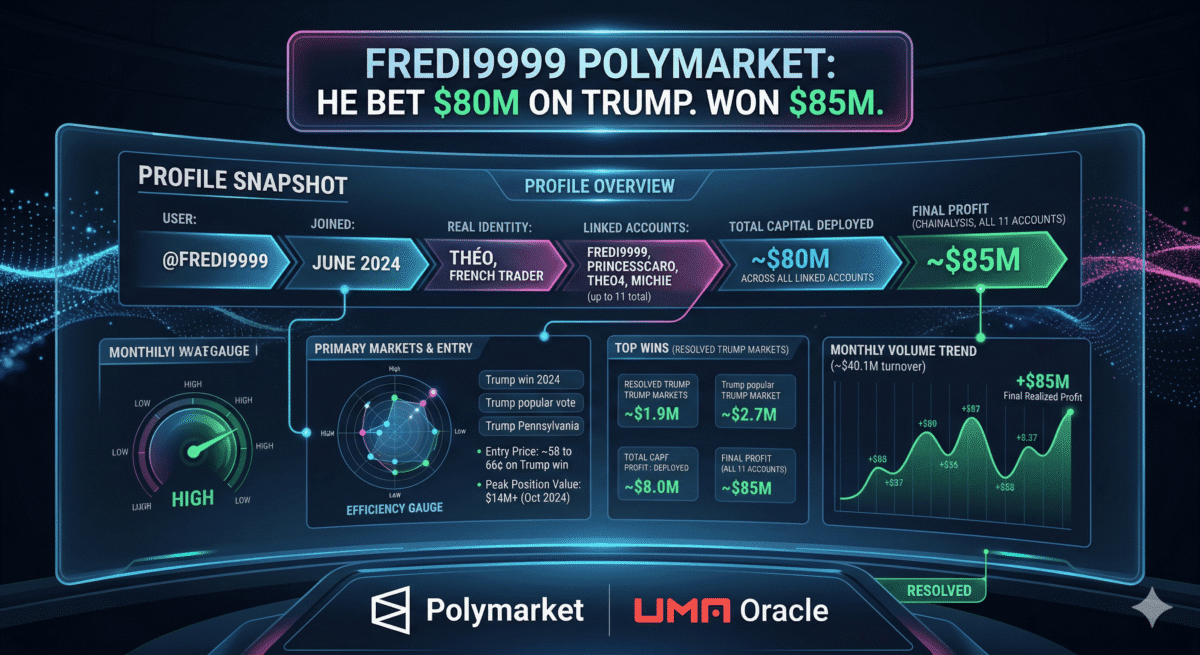
He Raised $80M, Commissioned His Own Poll, and Bet It All on Trump. Fredi9999 Walked Away With $85M.
TL;DR: Fredi9999 Polymarket is the username behind the most profitable single political trade in prediction market history. A French trader known as Théo, formerly of Wall Street, raised approximately $80M in liquid capital, deployed it across multiple linked Polymarket accounts, and built $14M to $30M in Trump 2024 election positions across winner, popular vote, and Pennsylvania markets. When Trump won, the full cluster of accounts including Fredi9999, PrincessCaro, Theo4, and Michie collected an estimated $85M in combined profit. Here is every confirmed position, the research methodology Théo actually used, how the fragmented buying strategy worked, and what the French regulatory investigation found afterward.
Show Image Caption: Fredi9999 Polymarket profile showing Trump election positions worth $14M+ as of October 2024. Source: Polymarket.com
The Wallet at a Glance
| Data Point | Detail |
|---|---|
| Username | Fredi9999 |
| Wallet Address | 0x1f2dd6d473f3e824cd2f8a89d9c69fb96f6ad0cf |
| Polymarket Profile | polymarket.com/profile/0x1f2dd6d473f3e824cd2f8a89d9c69fb96f6ad0cf |
| Joined | June 2024 |
| Real Identity | Théo, French trader, former Wall Street background |
| Linked Accounts | Fredi9999, PrincessCaro, Theo4, Michie (up to 11 total per Chainalysis) |
| Total Capital Deployed | ~$80M across all linked accounts |
| Initial Bloomberg Profit Estimate | ~$48M (4 confirmed accounts) |
| Final Profit (Chainalysis, all 11 accounts) | ~$85M |
| Primary Markets | Trump win 2024, Trump popular vote, Trump Pennsylvania |
| Peak Position Value | $14M+ across all Fredi9999 markets (October 2024) |
| Entry Price | ~58 to 66¢ on Trump win |
Who Is Théo? The French Trader Behind Fredi9999
The identity behind the Fredi9999 Polymarket accounts remained publicly unknown through the entire 2024 election cycle. In the months following Trump’s victory, reporting from Bloomberg, Chainalysis, and multiple crypto publications pieced together the profile.
Théo is a French trader with a former Wall Street background. He publicly stated his bets were purely profit-motivated rather than politically motivated. His approach to the 2024 election was not intuition or ideology. It was research-driven capital allocation executed at a scale that no other individual trader on any prediction market platform has replicated before or since.
The Fredi9999 account joined Polymarket in June 2024, just weeks before Elon Musk officially endorsed Trump and began his active campaigning role. That timing, combined with reports from someone in Republican circles who stated privately that Musk was preparing to endorse and donate heavily to Trump around May to July 2024, generated early speculation about whether Fredi9999 had early access to political intelligence. However, blockchain analysis ultimately found no evidence of insider information, and the account’s German-language forum activity in October 2023, asking tax questions related to living in Mallorca, is inconsistent with Musk’s profile and consistent with a wealthy European crypto trader.
The Research That Made the Trade: The YouGov Neighbour Poll
The most documented and distinctive aspect of the Théo approach is the proprietary research methodology he commissioned before deploying $80M into Trump election markets.
Rather than relying on standard polling that asked respondents directly who they planned to vote for, Théo commissioned YouGov to conduct a special poll across the three critical swing states of Pennsylvania, Michigan, and Wisconsin. The question was not “Who will you vote for?” The question was: “Who do you think your neighbour will vote for?”
The logic behind this approach reflects a well-documented phenomenon in political polling called social desirability bias. Some voters are reluctant to admit support for Trump directly, partly due to perceived social stigma. However, those same voters feel comfortable describing what they believe their neighbours will do, effectively revealing their own voting intentions indirectly. The “neighbour effect” poll captures this hidden preference in a way that standard polling methodology misses.
When the YouGov results came back showing stronger Trump support in the three swing states than mainstream polls indicated, Théo concluded the market had significantly mispriced Trump’s true win probability. He then executed on that conclusion at maximum scale.
The Position Structure: Every Confirmed Market
Trump Presidential Election Winner 2024
The primary position was on Trump winning the presidency outright. Fredi9999 accumulated more than 15 million shares on Trump Yes as of late October 2024, with that single position valued at approximately $8.7M at the time. He also held nearly 1.5 million shares on Trump carrying Pennsylvania.
Entry prices ranged from approximately 58 to 66¢ across the accumulation period. At those prices, a correct resolution paid 34 to 42¢ per share. Across 15 million shares on the winner market alone, the gross payout on resolution at 100¢ generated hundreds of millions of dollars in settlement value from which the original entry cost is subtracted.
Trump Popular Vote Winner 2024
The popular vote position is the most analytically ambitious call in the entire trade. No Republican presidential candidate had won the popular vote since 2004. The market priced Trump’s popular vote win as a longer shot than his Electoral College win, meaning entry prices were lower and the per-share upside was higher.
Théo built more than 3 million shares on Trump winning the popular vote, betting specifically that his YouGov neighbour poll had identified genuine hidden Republican preference in suburban areas that standard polling was not capturing.
When Trump won both the Electoral College and the popular vote in November 2024, both positions resolved at 100¢. The popular vote call produced the largest per-unit return of any position in the cluster because the entry price was most discounted relative to the true probability Théo’s research identified.
How Fragmented Buying Hid the Position Until It Was Too Late
The operational execution of the Fredi9999 Polymarket campaign is as documented and analysed as the analytical call itself.
Rather than entering $8M to $14M in single large orders, the accounts placed bets in increments of roughly $500 each, continuously through overnight sessions and extended daytime windows. At that frequency, a single account can place tens of thousands of individual transactions across days of accumulation without any single trade appearing whale-sized in the order book.
Specifically, economics professor Rajiv Sethi documented in October 2024 that Fredi9999 placed large limit buy orders slightly above the current best bid price, effectively setting a price floor on the Trump contract. Anyone wanting to bet against Trump during those overnight windows encountered Fredi9999 as the counterparty for virtually every trade, because the account was the only buyer willing to bid at that level through long stretches when US traders were asleep.
That strategy, which Sethi noted was nearly identical to a trader who deployed approximately $7M on Romney during the 2012 election cycle, accomplished two things simultaneously. It built a large position at close to the desired entry price, and it kept Trump’s market price elevated by absorbing all available No order flow. Whether the price elevation was intentional market influence or a structural side effect of accumulating a large position is the central question that generated the most controversy during the election cycle.
The Linked Account Cluster: $85M Across 11 Wallets
The initial Bloomberg estimate of $48M profit reflected only the four publicly confirmed accounts: Fredi9999, PrincessCaro, Theo4, and Michie. A subsequent Chainalysis blockchain analysis, also published by Bloomberg, identified up to 11 total accounts operating in coordination, which raised the estimated combined profit to approximately $85M.
An earlier estimate by Bloomberg had calculated a $48 million profit by analyzing the four accounts that were publicly attributed to Fredi9999 at the time. The Chainalysis analysis then connected additional wallets through on-chain fund flows and trading patterns that showed coordinated behaviour across all 11 accounts.
The Theo4 wallet, which now holds the #1 all-time profit position on Polymarket’s leaderboard at $22M, represents the single largest individual account in the cluster. The remaining $63M in combined profit spread across the other ten linked accounts, with Fredi9999 itself accounting for a substantial portion of the total given its documented $14M in peak position value.
The French Regulatory Response
The scale of the Fredi9999 Polymarket operation attracted immediate attention from France’s gambling regulator after Trump’s victory became public.
France’s Autorité Nationale des Jeux confirmed it was aware of Polymarket and was examining the platform’s operation and compliance with French gambling regulations. The investigation focused on whether Polymarket constituted an unlicensed gambling operation accessible to French residents rather than on the specific trades Théo made.
Polymarket is legally structured as a prediction market based outside France and is not available to US users following a 2022 CFTC settlement. However, the accessibility of the platform to French residents without regulatory approval created a compliance question that the Fredi9999 win brought directly into the regulator’s attention.
No enforcement action against Théo personally has been publicly confirmed. The regulatory scrutiny settled on Polymarket’s platform operations rather than individual trader activity.
The Manipulation Question: Did Fredi9999 Move the Market?
The most contentious question surrounding the Fredi9999 Polymarket campaign is whether the position-building meaningfully influenced Trump’s market odds in ways that affected media coverage and public perception.
Sethi documented that on October 7, 2024, there was a sharp increase in Trump’s Polymarket contract price that did not correspond to any new public information and was not mirrored on regulated competitor Kalshi. The Fredi9999 accumulation was the primary driver of that move.
Three interpretations exist. First, the position reflected genuine analytical conviction that the market had underpriced Trump, and the price movement was an accurate market correction toward true probability. Second, the position was designed to make Trump appear more likely to win as a form of political support, regardless of the trader’s actual probability assessment. Third, a combination of both motivated the strategy simultaneously.
Théo has publicly stated the bets were purely profit-motivated. The accuracy of the eventual outcome, Trump winning both the Electoral College and the popular vote, is consistent with the first interpretation. However, the specific strategy of setting a price floor by bidding slightly above the current best bid, rather than simply accumulating positions over time, is also consistent with deliberate price support.
The distinction between information aggregation and market manipulation in a legal prediction market environment remains genuinely ambiguous. No regulatory or legal finding has concluded that the Fredi9999 approach constituted manipulation rather than aggressive but legitimate prediction market trading.
What the Fredi9999 Trade Teaches About Prediction Markets
The Fredi9999 Polymarket campaign is the largest single political prediction market trade in documented history. Several specific lessons emerge from the full documented record.
Proprietary research creates genuine edge. The YouGov neighbour poll gave Théo information about true voter sentiment that the public polling consensus missed. The cost of commissioning a bespoke multi-state poll is trivial relative to $80M in deployed capital. Any trader with access to capital at this scale should consider original research a core operating cost rather than an optional extra.
Fragmented execution at large scale is an operational requirement, not an option. Entering $14M in Trump positions through single large orders would have moved the market price against the entry immediately. The $500 per transaction approach preserved entry prices across weeks of accumulation. At scale, execution methodology determines final returns as much as analytical accuracy does.
Linked accounts expand capital deployment without triggering single-wallet position limits or attention. The 11-account cluster allowed the full $80M deployment while keeping any single wallet below the threshold that would draw immediate tracker scrutiny. Understanding how coordinated multi-account operations function on Polymarket is essential for any serious analyst of large-scale prediction market activity.
Political events offer pricing inefficiencies that other markets close faster. The neighbour effect identified a genuine polling blind spot that standard models missed. When prediction markets misprice political outcomes relative to what careful original research reveals, the discrepancy can persist for weeks because the analytical barrier to identifying it is high.
Key Takeaways for CoinTrenches Readers
- $85M from a single election cycle is a record that may stand for years. No individual prediction market trader across any platform has come close to this outcome in any election cycle before or since. The combination of proprietary research, scale, and execution precision was unique to this specific campaign.
- The YouGov neighbour poll is the single most replicable element of the Théo approach. Any serious prediction market trader covering political events should consider commissioning original polling research on markets where public polling may suffer from social desirability bias. The cost is trivial relative to the edge it provides.
- Fredi9999’s current wallet shows $0.00 in open positions. The full cluster has been quiet since the election resolution. Whether Théo returns for the 2026 US midterms or other major political events is the most watched question in political prediction markets. Any activity from wallet
0x1f2dd6d473f3e824cd2f8a89d9c69fb96f6ad0cfwill generate immediate alerts across every tracker service. - The $85M figure reflects 11 wallets, not one. The Fredi9999 account alone shows a fraction of the total. Understanding the full linked account cluster requires tracking Theo4, PrincessCaro, Michie, and the additional Chainalysis-identified wallets simultaneously.
- The manipulation question remains genuinely open. The October 7 price spike that did not appear on Kalshi is the strongest evidence that Fredi9999 moved the Polymarket price independently of true probability signals. Whether that constitutes manipulation or aggressive legitimate accumulation has no definitive legal answer.
Keep Reading on CoinTrenches
- Theo4 Polymarket: $22M Profit. 14 Bets. $19 in Losses., the linked Theo4 account that holds #1 all-time on Polymarket’s leaderboard
- anoin123 Polymarket: $6.5M Lost on Iran No War Bet, what the losing side of a concentrated binary position looks like at scale
- GCottrell93 Polymarket: Nigel Farage’s Aide Lost $715K on Iran, another political insider who applied conviction betting to a geopolitical binary with a different outcome
- HorizonSplendidView: $2.37M on Man City Loss, how sports whales apply the same conviction sizing model to EPL markets
- ZachXBT Axiom Investigation: Whale Wallets Net $1.5M, how coordinated wallet clusters get tracked and exposed on Polymarket
This article is for informational purposes only and does not constitute financial advice. Polymarket odds change rapidly, always do your own research. Full disclaimer
![[Live] Polymarket UCL 2026 Odds: Arsenal Favorite at 29%](https://cointrenches.io/wp-content/uploads/2026/03/Live-Polymarket-UCL-2026-Odds-Arsenal-Favorite-at-29-768x419.png)