$14M Is Betting on Whether China Invades Taiwan by 2026. The Market Says 10% → Chance.
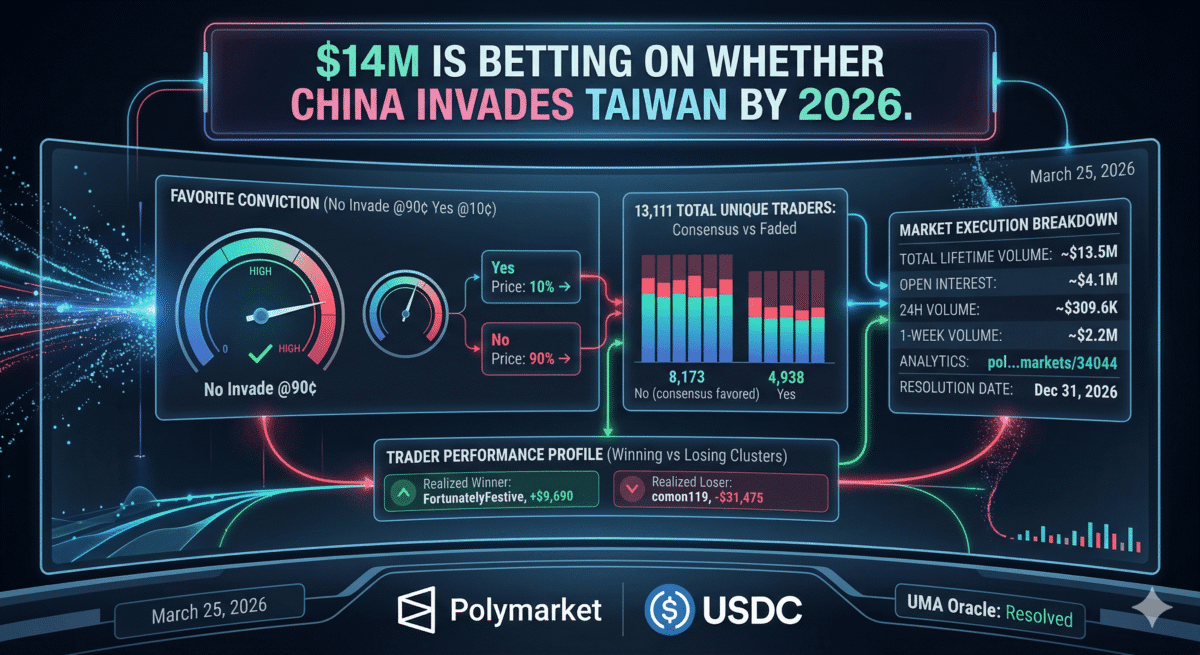
TL;DR: The Polymarket China invade Taiwan market has $14.7M in lifetime volume, 13,111 unique traders, and $4.1M in open interest. Yes sits at 10% →. No dominates at 90% →. comon119 holds 25% of all Yes shares and is currently the heaviest loser in the market at -$31,475. The market resolves December 31, 2026. Here is every known position, the exact resolution criteria, and what Western intelligence assessments say about the actual probability behind the 10¢ price.
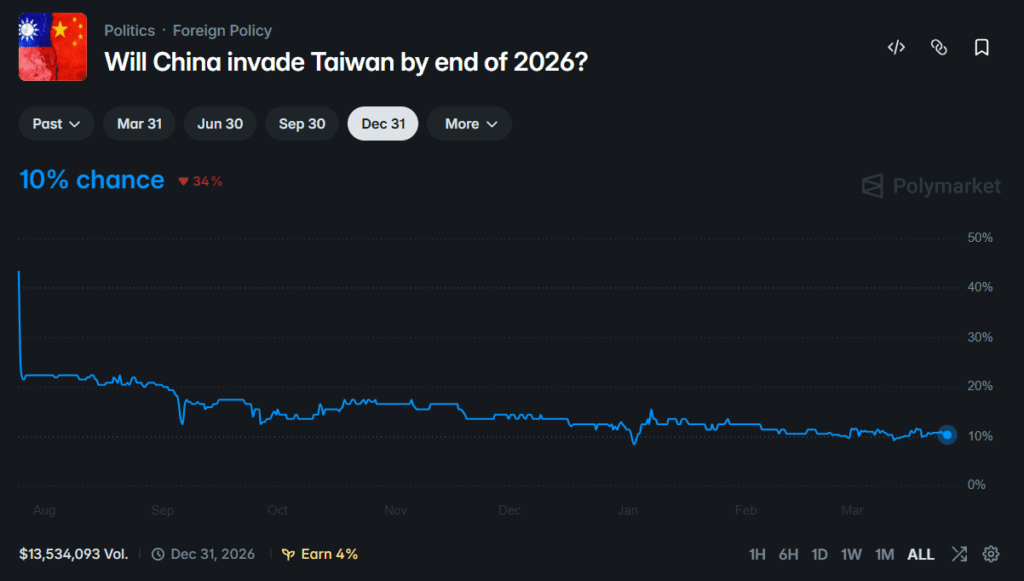
Polymarket China Invade Taiwan: Market at a Glance
| Data Point | Detail |
|---|---|
| Market | Will China invade Taiwan by end of 2026? |
| Analytics | polymarketanalytics.com/markets/34044 |
| Resolution Date | December 31, 2026, 11:59 PM ET |
| Yes Price | 10% → |
| No Price | 90% → |
| Lifetime Volume | $14.7M |
| 24hr Volume | $359.4K |
| 1-Week Volume | $2.1M |
| Open Interest | ~$4.1M |
| Total Unique Traders | 13,111 (4,938 Yes / 8,173 No) |
| Yes Volume | – |
| No Volume | – |
| Biggest Loser | comon119, -$31,475 |
| Biggest Winner | FortunatelyFestive, +$9,690 |
What Counts as an Invasion: The Exact Resolution Criteria
Before looking at any position in the Polymarket China invade Taiwan market, the resolution standard is the most important thing to understand.
The market resolves Yes if China commences a military offensive intended to establish control over any portion of the Republic of China by December 31, 2026. Territory under Taiwan’s administration including inhabited islands like Kinmen and Matsu qualifies. Uninhabited islands do not qualify.
Crucially, the exclusion list is specific and broad. A purely economic blockade without military action does not count. Cyber attacks and non-kinetic measures do not count. Chinese military exercises and drills around Taiwan, which happen regularly, do not count unless they transition into an actual offensive with control-establishment intent. Military posturing, threats, and political statements all fail the resolution standard.
The source of truth is official confirmation from China, Taiwan, the United Nations, or any permanent member of the UN Security Council, with a consensus of credible international reporting also qualifying. In practice, the criteria mean a genuine amphibious landing, sustained missile offensive against inhabited Taiwanese territory, or forcible blockade with military enforcement would trigger Yes. Anything short of a clear military offensive aimed at control does not which explains why 90% → holds so firmly despite elevated China-Taiwan tensions throughout 2025 and 2026.
Why Yes Sits at 10% →
The 10% → price reflects a convergence between prediction market crowd wisdom and mainstream Western intelligence assessments.
The Intelligence Consensus
US intelligence assessments released through 2024 and 2025 consistently placed a full-scale Chinese military invasion of Taiwan as a low-probability near-term event, with most analysts pointing to a 2027–2030 window as the period when Chinese military modernisation would reach sufficient capability for a high-confidence cross-strait operation. The People’s Liberation Army‘s amphibious capacity, logistics chain, and joint operations capability for a Taiwan invasion of the necessary scale have been assessed as not yet fully ready by multiple Western defence analysts. Specifically, a Taiwan invasion would require China to deploy the largest amphibious assault operation in modern military history against a heavily defended island a capability threshold that most outside analysts believe China has not yet fully crossed.
The Geopolitical Risk Factors That Keep Yes Above Zero
However, the 10% → price is not simply the residual probability of analysts being wrong about capabilities. Several specific scenarios keep Yes above the 0–2% range that pure capability analysis might suggest.
A Taiwan independence declaration remains the most commonly cited near-term invasion trigger in Chinese official statements and PLA doctrine. If the Taiwanese government formally declares independence, the political calculus for Beijing shifts dramatically regardless of operational readiness. At 10% →, the market prices this specific trigger scenario combined with military capability uncertainty as approximately one-in-ten plausible by year-end.
Trump-era policy unpredictability creates a second uncertainty layer. US security commitments to Taiwan under the Taiwan Relations Act have been consistent across administrations, but ambiguity about the scale and speed of US military response to a Chinese offensive introduces risk calculations that could theoretically embolden or deter Chinese action depending on specific diplomatic developments.
Additionally, the Iran conflict escalation visible across other active Polymarket markets demonstrates that geopolitical situations can move faster than most baseline assessments predict. The 10% → price partly reflects traders applying a general lesson from 2026: low-probability geopolitical events happen, and pure historical base rates underestimate specific tail risks.
Full Trader Breakdown: Winners, Losers, and Holders
Top 10 Winners — No Side Dominates
| Trader | PnL |
|---|---|
| FortunatelyFestive | +$9,690 |
| cqs | +$7,910 |
| onekey09 | +$6,683 |
| 0xB9…4680 | +$5,997 |
| momom | +$3,999 |
| linghujunlan | +$3,191 |
| risk-manager | +$3,165 |
| Istaroth | +$2,594 |
| NeH | +$2,458 |
| 7d74 | +$2,392 |
The winning side is entirely populated by No holders which reflects the market’s strong directional lean toward 90% →. Notably, the winning amounts are modest relative to the market’s $14.7M in total volume. The top winner sits at under $10K in realized PnL that reflects the structure of a high-No-probability market. No shares at 90% → offer only 10–11¢ of upside per share, and generating large profits requires enormous position sizes.
Top 10 Losers — Yes Side Bleeding
| Trader | PnL |
|---|---|
| comon119 | -$31,475 |
| seems1126 | -$13,098 |
| artus33 | -$3,772 |
| caspersmc | -$3,503 |
| expectless | -$3,038 |
| qqshia | -$2,600 |
| lol9009 | -$2,304 |
| vk7 | -$2,062 |
| bigdollapapi | -$1,621 |
| OldDomin11on | -$1,357 |
The losing side concentrates on Yes holders who entered at higher prices and now hold shares worth 10% → with resolution in December. comon119’s -$31,475 is the dominant loss and directly correlates with holding 25% of all Yes shares outstanding. At 10% → current price, those shares represent a position where the underlying thesis requires one of the most significant geopolitical events in modern history to occur within nine months.
Largest Current Holders
Yes side: comon119 at 25%, caspersmc at 7%, seems1126 at 6%.
No side: 0xB9…4680 at 10%, momom at 5%, onekey09 at 5%.
The Yes Holder Thesis: Why Anyone Bets on Invasion in 2026
Understanding why 4,938 traders hold Yes positions including comon119’s outsized concentration requires engaging honestly with the bullish invasion case.
The most coherent Yes thesis centres on Chinese leadership’s stated timeline. Xi Jinping has publicly stated the goal of reunification with Taiwan and has explicitly tied this to the 2049 centenary of the People’s Republic. However, some analysts interpret specific internal PLA communications and procurement patterns as suggesting 2026–2027 as an earlier operational target window rather than the post-2027 consensus view.
A second Yes thesis focuses on the Taiwan Strait military balance specifically. Chinese air force and missile capabilities over the Taiwan Strait have reached near-parity with Taiwan’s defensive systems according to some assessments. If Beijing believes it has achieved sufficient grey zone dominance to impose a blockade or limited strike campaign without triggering full US military intervention, the temptation to act before US force projection improves could create a 2026 window.
Furthermore, a broader geopolitical distraction argument appears repeatedly in prediction market discussions. The Iran conflict consuming US military planning bandwidth, diplomatic attention, and public political capital creates a window where US response to a Taiwan action might be slower or more hesitant than under normal conditions. None of these arguments make a 2026 invasion likely — but they combine to justify a price above zero, and for traders willing to accept deep binary risk for an outsized payout, 10% → on a genuine geopolitical tail event offers a 10-to-1 return structure that attracts systematic positioning.
Related Taiwan Markets: The Short-Term Picture
The December 2026 market does not exist in isolation. A series of shorter-deadline Taiwan invasion markets on Polymarket all show dramatically lower Yes prices — by March 31, 2026: less than 1% Yes; by June 30, 2026: approximately 2–3% Yes; by September 30, 2026: approximately 5–8% Yes.
That stepwise increase from near-zero short-term to 10% → full-year reflects the market’s view that invasion risk is not uniformly distributed across the year. Near-term invasion within the current military exercise cycle is essentially ruled out. The December price represents the full-year residual probability after short-term scenarios are excluded. For context, the Iran ceasefire market and US forces enter Iran market both demonstrate how geopolitical markets in this cluster respond to news cycles — Taiwan’s 10% → has been relatively stable, while Iran markets moved dramatically following the February 28 strikes. The difference reflects that Iran escalation had specific near-term catalysts, while Taiwan’s price represents a baseline geopolitical risk assessment without a comparable immediate trigger.
Key Takeaways for CoinTrenches Readers
10% → Yes reflects genuine probability, not noise. The 13,111 traders and $14.7M in volume represent serious capital engaging with a specific geopolitical risk. The price is not a random signal it reflects both capability assessments and political trigger analysis across a nine-month window.
comon119 holding 25% of Yes shares is the most concentrated single-position signal. At -$31,475 in current losses, this trader has held through the full market history without cutting. That persistence either reflects extreme conviction on the invasion thesis or a position size that makes exit feel too costly relative to the potential 10-to-1 payout.
No at 90% → offers limited upside. The winning position in this market returns only 10–11¢ per share. No is the correct analytical call but it is not a high-return trade. Meaningful returns require large position sizes on an outcome already strongly favoured by – in accumulated volume.
The resolution criteria exclude the most likely escalation scenarios. Military exercises, grey zone operations, and economic pressure all fail to resolve Yes. A genuine amphibious landing or sustained offensive against inhabited Taiwanese territory is the specific event the market prices — that narrow definition explains why even elevated China-Taiwan tensions throughout 2025 and 2026 have not moved the Yes price above 12%.
December 2026 is the full-year residual probability, not an imminent forecast. The stepwise increase across shorter-term markets from under 1% by March to 10% → by December — shows the market prices invasion as extremely unlikely in any specific short window but genuinely possible across the full nine-month horizon.
Keep Reading on CoinTrenches
- Polymarket Which Countries Strike Iran: UAE at 16% — another geopolitical coalition market with similar structure but faster-moving odds
- [Live] Polymarket US Forces Enter Iran: April 30 at 56% — the Iran ground entry market running in parallel to Taiwan escalation risk
- Polymarket Khamenei Out 2026: $57M in Payouts — how geopolitical leadership markets resolve and pay out at scale
- anoin123 Polymarket: $6.5M Lost on Iran No War Bet — what a large directional geopolitical bet looks like when it resolves against you
- ZachXBT Axiom Investigation: Whale Wallets Net $1.5M — how coordinated wallet clusters approach long-horizon geopolitical futures
This article is for informational purposes only and does not constitute financial advice. Polymarket odds change rapidly always do your own research. Full disclaimer →