Copy-Trading Polymarket Whales: When to Follow and When to Fade
Just because a whale bets $1M does not mean they are right. Specifically, the difference between informed capital and emotional hedging is the single most important distinction in Polymarket copy-trading strategy, and getting it wrong costs money in both directions. Following the wrong whale into an overpriced position is as damaging as missing the right one entirely. Furthermore, the Iran ceasefire insider wallets who made $663K were genuinely informed. The traders who lost millions on single soccer bets like imnotawizard and blindStaking were genuinely emotional. Both deployed seven-figure capital. Only one type was worth following. This guide covers the slippage trap that catches most copy-traders immediately after a whale alert, the whale-versus-whale scenario that signals genuine uncertainty rather than a clear edge, and the fade strategy for identifying and profiting against dumb money whales operating on emotion rather than information.
The Core Distinction: Informed Capital vs Emotional Hedging
Before any copy or fade decision, the foundational question is whether the whale placing the position has a structural reason to be correct or is acting from a different motivation entirely.
Informed capital enters a position because the wallet genuinely believes the market is mispriced relative to true probability. Specifically, this belief is supported by either superior information (as in insider activity), a systematic analytical model (as in the sports execution bots), or a documented track record of accurate calls in the same market category. The sovereign2013 sports bot placing $87,000 on an NBA spread at 44 cents is informed capital. It has 39,168 predictions, a 52.6% win rate, and $3.4M in all-time net profit. Following that position is a defensible decision with statistical backing.
Emotional hedging enters a position because the wallet is reacting to news, managing an existing exposure, or acting on personal conviction that has no analytical support. Specifically, a geopolitics trader who holds a large YES position on a ceasefire market deploying additional capital into a related conflict market to hedge unrealised losses is not expressing edge. Furthermore, a sports trader who just lost $1.5M on one match deploying capital into the next game at elevated size to recover losses is operating on emotion rather than analysis. Copying either of these positions without understanding the motivation produces negative expected value regardless of the position size.
The size of the position tells you nothing about which type you are looking at. The history behind the wallet tells you everything.
The Slippage Trap: Why Copying Immediately After a Whale Alert Costs You Money
How Whale Positions Move Market Prices Before You Enter
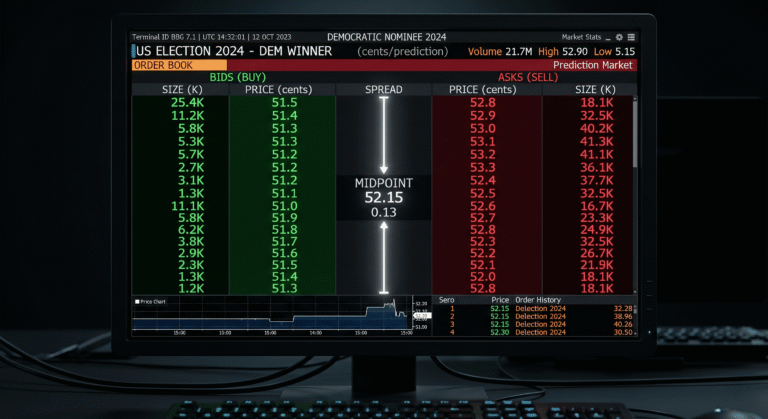
When a whale deploys $500,000 into a Polymarket market with moderate liquidity, the order does not fill at a single static price. Specifically, Polymarket’s Central Limit Order Book matches orders sequentially against available liquidity at progressively less favorable prices as each tranche of the large order fills. The result is that the whale’s average entry price is better than the price visible on the market immediately after the order completes.
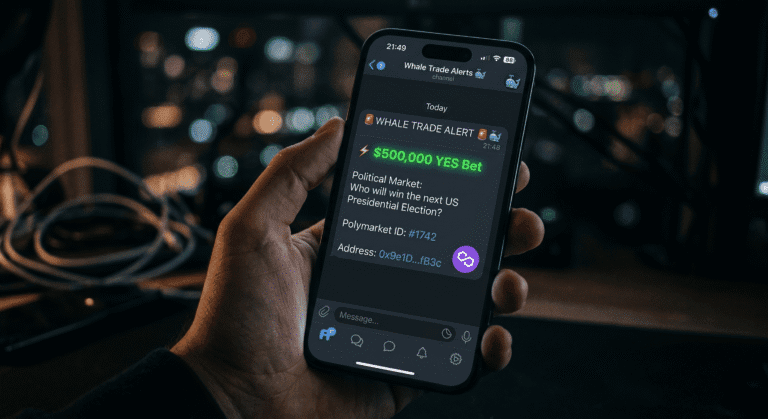
A trader who sees a whale alert and immediately market-buys the same outcome enters at the post-whale price, not the pre-whale price. Specifically, in a market where a whale bought YES shares at an average of 38 cents and the alert fires when the fill completes, the market price has already moved to 44 to 47 cents by the time the alert reaches your Telegram channel. As a result, you are buying the same position the whale bought but at a 16 to 24 percent markup on the entry price. Furthermore, if the whale’s position was correctly sized for a true probability of 50 cents, your entry at 47 cents leaves you with only 3 cents of theoretical edge rather than the whale’s 12 cents.
The Temporary Pump Pattern
Large whale entries create a temporary demand spike that pushes prices above the market’s true equilibrium. Specifically, the order book absorbs the whale’s buy and shifts the mid-price upward. Retail copy-traders who follow immediately amplify this move further. The combined demand from the whale fill and the copy-trader inflow creates a price peak that often reverses partially within minutes as market makers reprice liquidity.
This pattern is visible in documented Polymarket market data and is consistent with how large orders move prices in any CLOB-based market. The temporary pump is not permanent price discovery. It is a mechanical consequence of demand concentration that self-corrects as new liquidity enters at the elevated price.
The practical consequence is that the best copy entry is never the moment of the alert. Instead, monitor the market for 5 to 15 minutes after the whale fill completes. Specifically, if the price pulls back toward the whale’s entry level as the initial pump reverses, that pullback is your entry point. If the price continues rising above the post-whale level, the move is being driven by additional informed capital or breaking news rather than copy-trader momentum, and the signal quality is higher at that point.
Calculating Your Maximum Copy Entry Price
A simple rule prevents the slippage trap in most cases. Take the whale’s confirmed entry price from the alert. Add 8 cents as the maximum acceptable markup for a position with one to two months until resolution. Add 12 cents as the maximum for a position with more than two months until resolution.
If the current market price at the time you are considering entering is above the whale’s entry plus the applicable markup, do not enter. Wait for a pullback or pass on the position entirely. Specifically, entering a YES position at 54 cents that the whale bought at 38 cents turns a potentially profitable copy into a position where you need a 46 cent move just to break even, while the whale only needs a 62 cent resolution to break even. You are not copying the same trade. You are buying the whale’s profits before they are confirmed.
Whale vs Whale: What Opposing Large Positions Mean
When Two Informed Whales Take Opposite Sides
The most valuable signal in Polymarket copy-trading strategy is not a single large whale entering a position. It is two verified high-performing wallets taking opposite sides of the same market at comparable sizes. This pattern signals genuine market uncertainty at the highest analytical level and tells you something that no individual whale position can communicate on its own.
Specifically, when Theo4 and a comparably credentialed geopolitics wallet hold opposing positions in an election market at similar sizes, the market is pricing the outcome correctly. Both wallets are expressing their genuine analytical view, and the disagreement between them is real information: neither side has a decisive informational advantage. In this scenario, the correct response is not to copy either whale but to treat the market as efficiently priced and look elsewhere for edge.
The US Election markets of 2024 and the continuing political markets of 2026 produced multiple documented cases of this pattern. Specifically, markets where the largest YES and NO positions were held by wallets with comparable win rates and comparable market expertise in the same category were the markets that resolved closest to their final pre-resolution prices. The whale-versus-whale signal told traders that the market was efficient long before the resolution confirmed it.
When a Large Position Faces No Credible Opposition
The asymmetric scenario is more actionable for copy-trading purposes. Specifically, when a documented high-performing whale deploys a large position in a market where the opposing large positions are held by wallets with poor historical performance or no documented track record, the signal is directional rather than uncertain.
Look at the full order book context rather than just the whale’s position in isolation. If the largest NO positions on a market are held by accounts with no profitable prediction history, a fresh wallet pattern, or a concentration in markets where they have documented losses, the YES whale is not facing credible opposition. That asymmetry increases the signal quality of the copy trade substantially.
Furthermore, check the timing of the opposing positions. Specifically, if the large NO positions entered weeks before the whale’s YES entry and have not added to their position since the whale entered, the NO holders did not respond to the whale’s information. This suggests either they do not have access to the same analytical inputs or they are hedging an existing exposure rather than expressing fresh conviction.
The Convergence Signal
The highest-confidence copy scenario in the current Polymarket environment is what documented research calls the convergence signal: three or more top-performing wallets entering the same market on the same side within a 30-minute window without coordinating with each other on-chain.
This pattern is documented in the Iran ceasefire market, where the four insider wallets entered within hours of each other, and in multiple sports markets where high-frequency execution bots cluster into the same game lines when their independent models detect the same pricing inefficiency. Specifically, when three verified wallets with documented positive all-time PnL across at least 200 predictions each enter YES on the same market within 30 minutes, the convergence exceeds what independent coincidence can explain. Treat this as the strongest available buy signal and prioritise entry timing accordingly.
The Fade Strategy: Profiting Against Dumb Money Whales
What Makes a Whale “Dumb Money”
Dumb money in the Polymarket context does not mean low intelligence. It means capital deployed for a reason other than genuine edge detection. Specifically, three categories of whale activity qualify as dumb money in the context of Polymarket prediction markets.
The first category is emotional recovery betting. A wallet that has just absorbed a large loss and immediately deploys capital into a related or adjacent market at elevated size relative to its historical average is recovering emotionally rather than analytically. The imnotawizard profile is the documented example: $3.5M in soccer profits followed by a $2.4M single-position Liverpool bet at 62 cents on a team facing a two-goal aggregate deficit. The emotional conviction was high. The analytical edge was not present at that entry price.
The second category is hedging disguised as directional conviction. A wallet holding a large YES position in one market that enters a related NO position in another market is managing its existing portfolio exposure rather than expressing a new analytical view. Specifically, if a wallet has $400,000 in YES on a ceasefire market and enters $100,000 in NO on a related escalation market, the escalation NO is a hedge rather than an independent conviction trade. Copying the NO position as if it represents independent analytical edge is a mistake.
The third category is narrative-driven retail whale behavior. A large wallet that has no documented track record of profitable calls in a specific market category but deploys significant capital in that category after it becomes the dominant discussion topic on X is following narrative rather than analysis. The anoin123 $6.5M loss on Iran is the largest documented case of this pattern: narrative conviction at scale with no structural edge to support it.
How to Identify a Dumb Money Whale Before You Fade It
Four signals identify a dumb money whale reliably. Apply all four before committing to a fade position.
The first signal is win rate below 48% in the specific market category. A wallet with a 35% win rate in geopolitics markets but a 58% win rate in sports markets is a dumb money whale in geopolitics specifically, even if its overall track record is positive. Fade its geopolitics positions. Copy its sports positions. The category-specific win rate is more informative than the aggregate figure.
The second signal is position size significantly above the wallet’s historical average. A wallet that typically deploys $50,000 to $100,000 per position deploying $800,000 into a single outcome is sizing up beyond its analytical conviction level. Emotional certainty produces outsized position sizes. Analytical edge produces position sizes consistent with the wallet’s historical risk management framework.
The third signal is entry timing correlated with breaking news rather than pre-news positioning. A whale that enters a YES position on a ceasefire market three hours after the ceasefire is announced is not informed capital. It is late-moving capital chasing a narrative that is already priced. The Iran insider wallets entered before the announcement at 2.9 to 10.3 cents. A whale entering at 85 cents after the announcement is dumb money regardless of the position size.
The fourth signal is market category mismatch. A sports execution bot that has never documented a single geopolitics position suddenly deploying $200,000 into a political market is operating outside its documented edge domain. Similarly, a known geopolitics specialist deploying capital into a niche esports match is operating outside theirs. Fade any position where the wallet’s documented edge is in a different category from the market it is currently trading.
Executing the Fade: Entry, Sizing, and Exit Rules
A fade position is the opposite direction from the identified dumb money whale’s entry. Specifically, if the dumb money whale has bought YES on an outcome you believe is incorrectly priced, you buy NO at the current market price after the whale’s entry has created its temporary price pump.
The ideal fade entry is 5 to 10 minutes after the dumb money whale’s position fills. This timing captures the post-pump partial pullback that the whale’s demand spike generates and allows you to enter NO at a price that reflects the elevated YES price rather than the pre-whale equilibrium.
Size the fade position at 15 to 25% of the dumb money whale’s confirmed position size. Specifically, a $500,000 dumb money YES entry supports a $75,000 to $125,000 NO fade. Larger sizing increases the loss exposure if the dumb money whale turns out to be accidentally correct. Smaller sizing reduces the returns to a level that does not justify the analytical work required to identify the opportunity. The 15 to 25% range balances both concerns.
Exit the fade position when one of three conditions is met. First, the dumb money whale adds to its position. Specifically, a wallet that doubles down on a losing position is displaying continued emotional commitment and the market dynamics have not yet shifted against it. Exit and reassess. Second, a second credentialed high-performing wallet enters on the same side as the dumb money whale. The convergence of a dumb money wallet with an informed wallet changes the signal quality fundamentally. Third, the market resolves. If the fade position reaches resolution and resolves correctly, it pays out at $1.00 per NO share from your entry price. This is the baseline exit for all positions held to resolution.
Building a Decision Framework Before Every Copy or Fade
The Four Questions to Answer Before Entering
Every copy or fade decision should answer four questions in the order listed below before any capital is deployed.
The first question is: what is this wallet’s win rate in this specific market category? Retrieve the category-specific performance from polymarketanalytics.com or the wallet’s Cielo Finance profile. If the win rate in the specific category is below 50%, the copy case is not supported and the fade case becomes relevant.
The second question is: is the position size consistent with this wallet’s historical average? Pull the wallet’s recent position history and calculate the average size across the last 20 resolved positions in the same category. If the current position is more than 2x the historical average, treat it as emotional sizing and weight the dumb money classification accordingly.
The third question is: did this wallet enter before or after the relevant news event? A pre-news entry at low odds is the informed capital pattern. A post-news entry at elevated odds is the dumb money pattern. The timing relative to the key information event is the single most reliable classifier between the two types.
The fourth question is: is there credible opposition from a documented high-performing wallet? If yes, the market is efficiently priced and neither a copy nor a fade offers structural edge. If no credible opposition exists from a documented wallet, the copy or fade case strengthens depending on which type the original whale represents.
Position Sizing Rules for Copy Trades
Never size a copy trade above 30% of the whale’s confirmed position. Specifically, a $1M whale position supports a maximum $300,000 copy position under this rule. Larger sizing amplifies the slippage trap problem described earlier and increases concentration risk in a position where you are dependent on another trader’s accuracy rather than your own independent analysis.
For convergence signals (three or more wallets on the same side), the maximum copy size increases to 40% of the average position size across the converging wallets. The higher confidence of the convergence signal supports slightly larger allocation.
For fade positions against identified dumb money whales, cap the position at 20% of the dumb money whale’s entry size as a conservative starting point and only increase to 25% if a second identification signal confirms the dumb money classification.
Real Examples From Documented CoinTrenches Research
When Following Was Right: The Iran Ceasefire Convergence
The four wallets documented in the Iran ceasefire insider trade each displayed the informed capital pattern clearly. Fresh wallet creation, immediate single-market deployment, near-identical capital sizing across four separate accounts, and pre-news entry at 2.9 to 10.3 cents. A trader running the alert system described in the Polymarket whale alerts guide who caught the convergence of four separate fresh wallet entries on the same market within hours would have had a clear copy signal before the announcement.
When Fading Was Right: The Liverpool Bet
The imnotawizard Liverpool position showed every dumb money signal simultaneously. Category-consistent win rate (soccer) but position size $2.4M against a historical pattern of $400,000 to $700,000 per position. Entry at 62 cents on a team needing to overcome a two-goal aggregate deficit. No documented convergence of other high-performing soccer wallets entering the same side. A trader who identified the emotional sizing and faded with a $400,000 to $600,000 NO position at 38 to 40 cents captured the full payout when PSG confirmed.
When Neither Was Right: The US Election Whale vs Whale Markets
The 2026 political markets where Theo4 and comparably credentialed geopolitics wallets held opposing positions of similar sizes at similar prices were the textbook whale-versus-whale scenario. Both sides had documented track records. Neither side had a decisive informational advantage visible from on-chain data. The correct response was no entry. The market resolved near its pre-resolution price, confirming that the efficient pricing signal from the whale-versus-whale pattern was accurate.
Key Takeaways for CoinTrenches Readers
The slippage trap destroys copy-trade returns before the position even opens. Specifically, entering more than 8 to 12 cents above a whale’s confirmed entry turns a copy trade into a purchase of the whale’s potential profit at a premium. Wait for the post-pump pullback and enter at the corrected price or pass entirely.
Whale size communicates nothing about whale quality. The $2.4M Liverpool position and the $663K ceasefire position were both whale-scale. One was informed capital. One was emotional hedging. The wallet history, category win rate, position sizing consistency, and entry timing relative to news are the four metrics that distinguish them.
Whale-versus-whale is a do-nothing signal. When two credentialed wallets hold opposing large positions in the same market, the market is efficiently priced. Neither copying nor fading offers structural edge in that scenario. The analytical work required to identify which whale is right is not compensated by the available edge after the two whales have already pushed the price toward equilibrium.
The fade strategy requires as much research as the copy strategy. Specifically, identifying a dumb money whale is not intuitive. It requires pulling the category-specific win rate, comparing the current position size to the historical average, checking the entry timing relative to the news event, and verifying the absence of credible opposition. Fading without completing this research produces losses as reliably as copying blindly.
Frequently Asked Questions
What is the difference between informed capital and emotional hedging on Polymarket?
Informed capital enters a Polymarket position because the wallet has a genuine analytical or informational reason to believe the market is mispriced. Specifically, this is evidenced by a documented track record of profitable calls in the same market category, a pre-news entry timing pattern, and position sizes consistent with the wallet’s historical average. Emotional hedging enters a position because the wallet is reacting to news, managing an existing portfolio exposure, or acting on personal conviction without analytical support. Size alone does not distinguish the two. Category-specific win rate, position sizing consistency, and entry timing relative to news events are the reliable classifiers.
Why should I not copy a Polymarket whale immediately after the alert fires?
A whale deploying $500,000 into a Polymarket market moves the price against itself as the order fills through the order book. By the time the alert fires in your Telegram channel, the market price is already 6 to 15 cents above the whale’s average entry price. Entering at this elevated price reduces your theoretical edge from the whale’s 12 cents to 3 cents or less and can produce a loss even if the whale’s analytical thesis is correct. Wait 5 to 15 minutes after the alert, monitor for a partial price pullback, and enter at the corrected price rather than the post-whale peak.
What does whale vs whale mean on Polymarket and how should I respond?
Whale versus whale refers to a market where two or more documented high-performing wallets hold large opposing positions on YES and NO simultaneously. Specifically, this pattern signals that the market is efficiently priced at the level where two sophisticated analytical participants disagree. The correct response is neither to copy nor to fade either whale but to treat the market as too efficiently priced to offer structural edge and look for copy or fade opportunities in markets where the whale positioning is uncontested by credible opposition.
How do I identify a dumb money whale on Polymarket?
Four signals identify a dumb money whale reliably. First, a win rate below 48% in the specific market category currently being traded. Second, a position size more than twice the wallet’s historical average for the same category, indicating emotional rather than analytical sizing. Third, entry timing correlated with breaking news rather than pre-news positioning, confirming the wallet is chasing a narrative rather than acting on edge. Fourth, market category mismatch where the wallet is trading outside its documented area of analytical expertise. Two or more of these signals appearing simultaneously is sufficient to classify the position as dumb money and evaluate a fade entry.
How large should my copy trade be relative to the whale’s position?
Cap copy trades at 30% of the whale’s confirmed position size as a standard rule. For convergence signals where three or more credentialed wallets enter the same market on the same side within 30 minutes, increase the cap to 40% of the average converging position size. For fade positions against identified dumb money whales, cap at 20% of the dumb money whale’s entry size and only increase to 25% if a second identification signal confirms the dumb money classification. Never size a copy or fade position to the point where a single incorrect resolution produces a loss that materially affects your overall trading capital.
Can I use copy-trading bots to automate whale following on Polymarket?
Automated copy-trading tools like PolyGun and Kreo (covered in the whale alerts guide) can mirror a specific wallet’s trades automatically. However, the slippage trap applies with full force to automated copying because the bot enters at market price immediately after the whale’s fill, producing the worst possible entry in terms of post-pump pricing. Automated copying works best when applied to high-frequency systematic wallets like sovereign2013 whose positions are small relative to market liquidity and whose edge is consistent enough that the slippage cost is outweighed by the win rate. For large single-position geopolitics or soccer whales, manual timing of the copy entry after the post-pump pullback consistently outperforms automated copying.
Keep Reading on CoinTrenches
Real-Time Polymarket Whale Alerts: Full Setup Guide 2026 — the companion guide for building the alert system that delivers the copy and fade signals described in this article
How to Find Polymarket Whales on Polygonscan: Full Guide 2026 — the on-chain research method for identifying and classifying whale wallets before adding them to your tracking list
Polymarket Insider Traders: $663K on Iran Ceasefire in One Bet — the documented informed capital case study referenced in this guide, showing exactly what a follow signal looks like in practice
imnotawizard Polymarket: $2.4M Lost on Liverpool vs PSG — the documented emotional hedging case study referenced in this guide, showing what a fade signal looks like in practice
Theo4 Polymarket: $22M Profit, 14 Bets, $19 in Losses — the highest all-time profit wallet on the platform and the benchmark for informed capital identification
sovereign2013 Polymarket: $3.4M All-Time, Sports Bot Full Profile — the highest-confidence systematic copy target in the current sports whale tier, with nine months of documented edge across NBA, NCAA, and MLB markets